Archive | culture RSS feed for this section

Live from New York …

3 Dec

Patrick Novecosky is interviewed on the Busted Halo Show (Sirius XM Radio) by Paulist Father Dave Dwyer

DECEMBER 3, 2010 — Patrick Novecosky, editor of this blog, had the opportunity to visit the Sirius XM Studios in Midtown Manhattan this week. Father Dave Dwyer, a Paulist priest, is the host of the Busted Halo Show on The Catholic Channel (Sirius XM Satellite Radio). He gave a quick tour of the studio (including Howard Stern’s office/studio) and the little studio where, he said, Bruce Springsteen performed live last week.

One of the most dynamic priests you’d ever want to meet, Father Dave brought Novecosky into his studio for a chat last night — Thursday, Dec. 2. They talked about writing, journalism, Legatus, the Catholic Church and Novecosky’s faith journey … all punctuated by a laugh or two.

Take a listen by clicking here.

A renaissance of faith-friendly films?

4 Oct

OCTOBER 4, 2010 — If you’re a concerned Christian parent like me, you’re concerned about all of the negative influences bombarding your children every day. No matter how well you protect them from advertising, movies and other messages with a secular, hedonistic worldview, some will filter through.

Jim Caviezel as Jesus in THE PASSION OF THE CHRIST

Despite the onslaught of negative messages, Christians haven’t given up. I’ve been following the development of Christian media for years. Like many others, I fully expected a rush of Christian films to hit the big screen after Mel Gibson’s $611-million blockbuster The Passion of the Christ six years ago. It didn’t happen. One studio, New Line Cinema, made a weak attempt to provide a Christian picture when it released The Nativity Story in 2006. Despite the hype and its Vatican City world premier (sans the Pope), Christian film-goers were unimpressed. And irony of ironies, its teen star Keisha Castle-Hughes announced she was unwed and pregnant just prior to the film’s release. The movie tanked, earning only $45 million.

Fireproof and Courageous

Since then, Christian filmmakers have struck out on their own, making high-quality films outside the studio system. In 2008, for example, Sherwood Pictures in Albany, Ga., released Fireproof. With a tiny $500,000-budget, the film — starring Kirk Cameron (who took no salary) — grossed more than $33 million. The pro-marriage flick debuted at No. 4 and was the highest-grossing independent film of the year! The church-based studio is busy on its next film film, Courageous, which addresses one of the biggest social epidemics in our culture today — the crisis of fatherhood. Too many fathers are either absent, abusive or neglectful.  Studies show this epidemic has let to an increase in crime, gang activity, homosexuality — and even more absent, abusive and neglectful fathers.

On the set of COURAGEOUS in Albany, Ga., in May with producer/writer Stephen Kendrick (above) and my son (below)

I had the blessing of being on the Courageous set (with my own son) in May. I met with the filmmakers and the dozens of locals who have developed spin-off businesses around Sherwood Pictures.

Courageous will be the studio’s fourth picture. The others were Flywheel, Facing the Giants and, of course, Fireproof. The exciting thing about what Sherwood is doing is that they are Christians making films for Christians. They get it. Studios don’t. I once worked for a Catholic company that engaged a secular PR firm to help get its message out. It was painful. As much as the PR reps wanted to get the message out correctly and effectively, they didn’t think like us, making the entire endeavor more arduous than any of us had ever imagined.

The same is true with movies. If a studio boss tells his Yes-men, “Get me a Jesus picture!” They’ll do it, but unless Christians write, produce, direct and star in it … it will ring hollow. Case in point, The Nativity Story.

Secretariat

There are a number of films either just out or in production that we have to look forward to in the coming months. Christian media (and PR teams) are busy promoting Disney’s Secretariat as the next Blind Side. Starring one of my favorite actresses, Diane Lane, it tells the story of Penny Chenery and Secretariat, who became the first horse in 25 years to win the Triple Crown in 1973. It’s in theaters Friday, so we’ll see if it wins Lane an Oscar as The Blind Side did for Sandra Bullock.

Cristiada

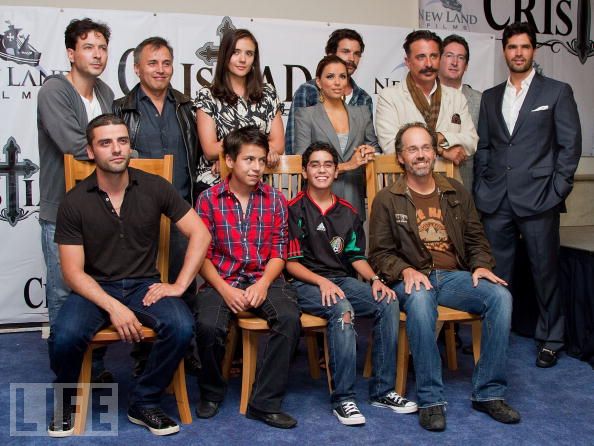
Cast of the upcoming Andy Garcia project CRISTIADA, which just wrapped filming in Mexico

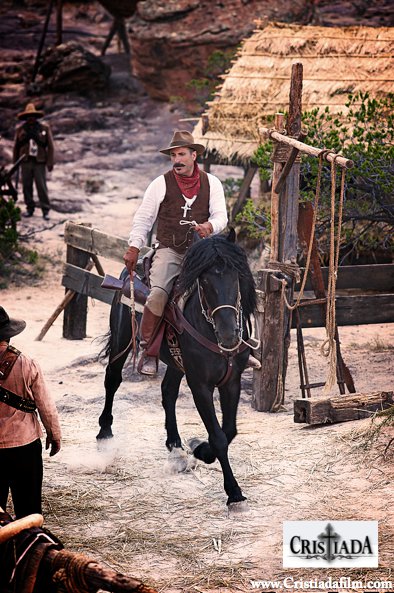
A film that I’m personally looking forward to is Cristiada (official site), starring Andy Garcia, Eva Longoria Parker, Peter O’Toole and Eduardo Verástegui.  The film weaves itself around the Cristero War (also known as the Cristiada ) of 1926 to 1929. It was an uprising and counter-revolution against the Mexican government of the time, set off by religious persecution of Catholics, specifically the strict enforcement of the anti-clerical provisions of the Mexican Constitution of 1917 and the expansion of further anti-clerical laws.

I intereviewed Verástegui in person a few years ago when he was out promoting the release of Bella, the pro-life film that captured the hearts of movie-goers at the 2006 Toronto International Film Festival, one of the most prestigious festivals in the world.  Bella won the People’s Choice Award, the same award that sent Slumdog Millionaire on its path to Oscar gold two years later.

When I talked to him, Verástegui told me that he had renounced films that denigrate his race (he’s Mexican) or his faith (he’s Catholic) or that would offend God in any way. Since Bella, he’s only made one film — the touching 20-minute short, The Butterfly Circus. I fully expect every Verástegui project to be a winner. He’s talented, popular and fully committed to his faith.

Andy Garcia on the set of his new movie CRISTIADA

His reversion to the Church came after his first major success in the U.S. (he’s called the Mexican Brad Pitt because his popularity south of the border rivals that of Mr. Jolie). He fired his staff and sought God’s will. He thought he’d go off to South America and become a missionary, but his spiritual director wisely pointed him back to the jungles of Hollywood where evangelization is far more desperately needed than in the wilds of the Amazon. After turning down dozens of projects that didn’t meet his new faith-based standards, he was broke and living in his Cadillac Escalade. (Only in Hollywood!) Then God’s Providence led him to Leo Severino and Alejandro Gomez Monteverde. The Three Amigos birthed Metanoia Films and Bella. The rest is history … and their future has just begun.

There Be Dragons

Next, the new Roland Joffé,  (The Killing Fields, The Mission) film is already generating a ton of buzz in Catholic and secular circles. Like Cristiada, There Be Dragons is a historical epic. Based on an script originally penned by Catholic screenwriter Barbara Nicolosi, Joffé directs the film set during the Spanish Civil War. According to publicity material, the film’s themes include betrayal, love and hatred, forgiveness, friendship, and finding meaning in everyday life. The film, scheduled to be released next spring, includes the story of revolutionary soldiers, a journalist, his father, and a priest, St. Josemaría Escrivá — a recent Roman Catholic saint and founder of Opus Dei. Escrivá has been called the saint of ordinary life.

There Be Dragons doesn’t boast Cristiada’s all-star cast,  but still brings an impressive slate of veteran actors including Charlie Cox (Stardust), Wes Bentley (American Beauty), Rodrigo Santoro (300), Dougray Scott (Desperate Housewives) and Bond girl Olga Kurylenko (Quantum of Solace).

The film has received indirect support from the personal prelature Opus Dei, which Escrivá founded. Although maligned by Dan Brown in The Da Vinci Code and its sequel Angels and Demons, Opus Dei actually recorded a bounce in membership and attention thanks to the books and films. The organization seems poised to capitalize on this new film, which is sure to generate more interest for Opus Dei — albeit far more positive attention. No murderous albino monks here.

Motive Entertainment, which led the pre-screening blitz for The Passion and the first Chronicles of Narnia film, is already bringing Dragons to leaders with screenings across the country this fall. So far the buzz has been positive. Joffé, who is an agnostic, told the National Catholic Register‘s Tim Drake, “When I decided I would do the movie, I wondered what Josemaria Escrivá might say. I think he would be delighted. He had an all-embracing view of human beings. If certain of our values are lining up, how wonderful that is and what a rich world God’s is.” Read the rest of the interview.

Mary Mother of Christ

Camilla Belle. Hope they change her eye color from blue to brown in post-production!

Nicolosi and her company Origin Entertainment are behind one of the more anticipated upcoming films — the $36-million production of Mary Mother of Christ starring Camilla Belle (The Lost World: Jurassic Park ) as Mary, Al Pacino as Herod and Peter O’Toole as Simeon. Nicolosi tells me that “the shooting has been delayed several times due to financing troubles related to the current economy. The current schedule is for the project to shoot in Jordan in January.” With Nicolosi’s involvement — and the star power of Pacino and O’Toole — this will be one to keep an eye on!

There are several just-released films and some in the hopper worthy of note: the newly released Like Dandelion Dust is being marketed to Christians, a film on Our Lady of Guadalupe is being penned by famed Hollywood screenwriter Joe Eszterhas, Rust (produced and starring Corbin Bernsen came out on DVD this week), The Mighty Macs (which will hopefully be released to DVD soon), a film billed as the Christian version of the Oscar-winning Crash called I Am, and a German film on the 12th century mystic St. Hildegard of Bingen called  Vision. Oscar winning actor Lou Gossett Jr., a professed Christian, may have another hit on his hands with The Grace Card, which hits theaters on Feb. 25, 2011. And soon out on DVD is Robert Duvall’s sensational Get Low.

With the November elections just around the corner, watch for I Want Your Money. And lastly, every adult Christian should understand the horror of abortion. Two phenomenal films that expose the underbelly of the beast we euphemistically call the “abortion industry” are Blood Money (news article) and Maafa 21.


A few more for your consideration (all new on DVD): Bringing Up Bobby, The Mysterious Islands, Upside, the phenomenal Letters to God, The Secrets of Jonathan Sperry and last but not least … my favorite Christian-themed movie of the year: To Save A Life.

With a plethora of films that go against the Hollywood mainstream, we may be witnessing the slow birth of a renaissance in faith-friendly film. Time will tell.

Patrick Novecosky is the founder and editor of The Praetorium.

Pope Benedict makes a splash in the UK

21 Sep

SEPTEMBER 21, 2010 — Despite the fact that secularism has nearly overrun the United Kingdom over the past few decades, the celebration that surrounded Pope Benedict XVI’s historic visit last week was a breath of fresh air. Nearly 100,000 strong gathered to welcome him to Scotland when he landed there on Sept. 16.

Pope Benedict exchanges gifts with Queen Elizabeth

The visit made history on several fronts. It was the first ever state visit to the UK by a pope. Former British Prime Minister Gordon Brown invited the Holy Father in February 2009. Pope John Paul II’s 1982 trip to the UK, by contrast, was a pastoral visit.

On the last day of Benedict’s four-day trip, he beatified Cardinal John Henry Newman, the preeminent Catholic convert of the 19th century. Newman is the first non-martyred Englishman to advance toward canonization since King Henry VIII sat on the throne. It was also the first beatification Pope Benedict has presided over.

Although these “firsts” are significant, perhaps even more significant is the thawing of anti-Catholic sentiment that began to brew in the weeks leading up to the visit. A few prominent atheists called for the Pope’s arrest earlier this year due to the sexual abuse scandal, various secular pundits took swipes in the media at Catholics, and on the second day of the visit, five men were arrested for concocting a terrorist plot against the Pope. Another was arrested the following day. No doubt the prayers of the faithful were instrumental in disrupting the plot.

Pope Benedict’s deliberate and effective message of respect, tolerance and dialogue struck a chord with his listeners. In a live broadcast message to Catholic schools across the UK, he told students that effective science and research require open minds. “The world needs good scientists, but a scientific outlook becomes dangerously narrow if it ignores the religious and ethical dimension of life, just as religion becomes narrow if it rejects the legitimate contribution of science to our understanding.”

In the most delicate political address of his trip, the Holy Father addressed 1,800 British politicians, business leaders and intellectuals at Westminster Hall, the very spot where St. Thomas More was condemned to death in 1535 for refusing to accept Henry’s Act of Supremacy over the Church of England.

Pope Benedict presides over Cardinal Newman's beatification in Birmingham, England

“If the moral principles underpinning the democratic process are themselves determined by nothing more solid than social consensus,” the Pope said, “then the fragility of the process becomes all too evident. Herein lies the real challenge for democracy.” Among those attending were former prime ministers Margaret Thatcher, John Major, Tony Blair and Gordon Brown. The Pope greeted each one personally before leaving the hall amid great applause.

Cool weather and sporadic sprinkles of rain were no obstacle to the 55,000 pilgrims attending the beatification of Cardinal Newman on Sunday. In his homily, the Holy Father said that “in Blessed John Henry, that tradition of gentle scholarship, deep human wisdom and profound love for the Lord has borne rich fruit, as a sign of the abiding presence of the Holy Spirit deep within the heart of God’s people, bringing forth abundant gifts of holiness.”

It remains to be seen whether or not the new Blessed’s intercession will result in a revival, but one thing is sure: The UK will forever be a little brighter after seeing the successor of Peter.

Patrick Novecosky is the founder and editor of The Praetorium.

Kresta in the Afternoon

15 Sep

SEPTEMBER 15, 2010 — I had the honor of being the final guest on Kresta in the Afternoon yesterday. The daily program is produced byAve Maria Radio and heard around the world on EWTN Radio and Sirius/XM Satellite Radio.

Host Al Kresta asked me about the week-long seminar for journalists from around the world I attended in Rome last week, from Sept. 6-12. I was among 27 journalists from eight nations who attended The Church Up Close: Covering Catholicism in the Age of Benedict XVI, organized by the School of Church at the Pontifical University of the Holy Cross.

My three blog posts (1, 2, 3) about the seminar have been read by people from around the world. Al asked me about why secular journalists don’t understand religion. We also delved into the various sessions the seminar offered, including a visit to the Vatican Press Office, the Congregation for the Doctrine of the Faith and dozens of seminars over the course of the week.

Click here to listen (Opens in a new window. 13:57 minutes).

Livin’ la vida Roma

9 Sep

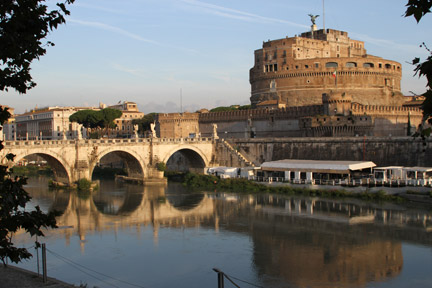
Castel San Angelo

SEPTEMBER 9, 2010 — Blogging from Rome isn’t easy. It’s like asking a child who rarely goes out to play to come in from the playground. To make that analogy complete … there’s no school bell. Rome is a Catholic playground in the sense that it’s one of the best places in the world to learn about and become immersed in our faith.

After landing in Rome on Sunday morning, I had two objectives: To find a Sunday Mass and to get some sleep. Both were easy to find. I took the Metro (train) from the airport to the Termini (main terminal downtown), then caught a short cab ride to my hotel. The guy behind the desk said my room wasn’t ready and he didn’t have a list of Mass times. I only had to wait 20 minutes before my room was ready, so I checked in then walked a block to the nearest church. If you’ve never been to Rome, you have to realize that churches are so close together in the main part of the city that you rarely have to walk more than two blocks to find one. Not only that, but most are huge, old and beautiful. Sadly, they are also under-used.

Vaticanisti
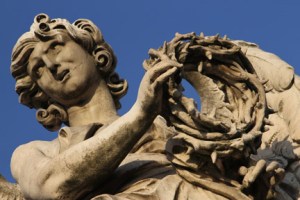
Angel on Ponte Sant'Angelo

The seminar I’m here for — The Church Up Close: Covering Catholicism in the Age of Benedict XVI — is being held at the Pontifical University of the Holy Cross (aka Santa Croce) — one of several pontifical universities and one of the newest. The course has attracted 27 journalists from eight countries. I initially expected the seminar would draw secular journalists who were eager to learn more about the Church and how it operates. However, most of the folks I’ve met here so far are pretty well-versed in Church teaching and its position on most issues. What I’m finding, however, is that we’re here for a deepening in our understanding on how the Church operates and its position everything from stem cell research, the sexual abuse crisis, poverty, and how the Holy See communicates with the world.
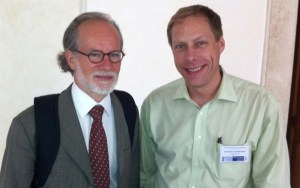
With John Thavis

Our first day, Monday, was a full day in the classroom. We were treated to a session on the nature and mission of the Catholic Church. Father Paul O’Callaghan, a Santa Croce professor, gave us a quick snapshot of the Church’s origin in the Jewish people through to Jesus Christ, the apostles and their successors. Later in the day, two “Vaticanisti” treated us to a few hours of what it’s like to be a full-time Vatican reporter. Catholic News Service Rome Bureau Chief John Thavis, whom I’ve met several times before, and Trish Thomas of the Associated Press TV, relished us with dozens of stories from their experiences with both Pope John Paul II and Pope Benedict. Both agreed that the most memorable and rewarding experiences came during papal trips overseas — in particular traveling on the papal plane.

Thavis talked about his first attempts to get interviews with Vatican cardinals. He quickly learned that “ambush interviews” don’t work, meaning that waiting to catch a cardinal or other church officially without making an appointment or putting in a request, just doesn’t fly. His point was that the learning curve for most Vaticanisti is rather long.

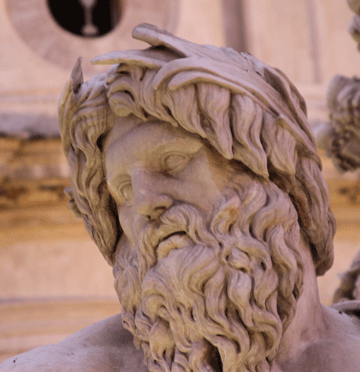
Detail of fountain, Piazza Navona

One of the more fascinating differences between Benedict and John Paul is the way they interact with journalists on the plane. Normally, 40-60 journalists travel on the pope’s plane when he travels abroad. John Paul occasionally waded into the crowd of journalists at the back of the plane. He sometimes sat and bantered with them for an extended period of time. Thavis said later journalists would share their taped interviews with the pope, which made for compelling stories. Pope Benedict, on the other hand, is more comfortable taking pre-submitted questions. Both Thavis and Thomas agreed that the pope isn’t afraid to choose from the tougher, more controversial questions. The answered a question about condom use on a trip to Africa several years ago. Both seemed to expect the pope’s upcoming trip to the UK will be a great success despite some of the controversies swirling about.

Inside the Vatican

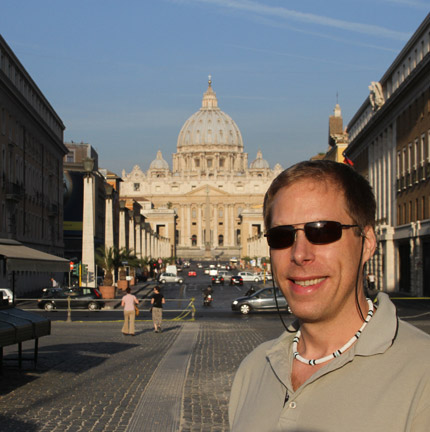
St. Peter's Basilica in the morning light

I began this post talking about Rome as a playground for Catholics. Tuesday kicked off by a morning tour of the Vatican museums and the Sistine Chapel. Liz Lev, art historian and one of the best tour guides in the Eternal City, led us through three-hour blitz through the museums, capped by a fascinating visit to the Sistine Chapel. It was my third visit to the museums, but certainly the most in-depth experience.

Liz Lev leading our tour of the Vatican Museums

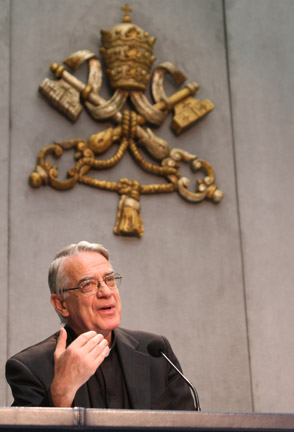
After a short break, we crossed the street to the road leading directly into St. Peter’s Square — Via Conciliazione — to the Holy See’s Press office. Papal spokesman Fr. Federico Lombardi, SJ, spent a full hour with us. He began by explaining the history and role of the Press Office. He talked about his work, his challenges, and how he interacts with the 400 journalists (Vaticanisti) accredited to the Holy See. One of the challenges the Press Office is the challenge of explaining the more complex Church documents and positions to journalists. Lombardi also stressed that it’s essential for the Church to be transparent in the more difficult questions posed to the Church, in particular the sexual abuse of minors.

Fr. Federico Lombardi, SJ, Director of the Vatican Press Office

The Holy Father will visit Glasgow, London and Birmingham next week. Father Lombardi said they feel no “trepidation” about the trip despite some popular atheists and groups calling for officials to arrest the pope. He said polls in the UK are mostly positive regarding the visit, and that the Pope will explain what the Church has to offer the people of England and Scotland.

Our evening session took place at the offices of the Congregation for the Doctrine of the Faith. American priest Monsignor Charles Brown, a staff member at the CDF, gave us a fascinating overview of the office’s history, its link to the Inquisition and its relationship to Pope Benedict, who was the prefect of the CDF before becoming pope.

Papal Audience

With Cardinal John Foley

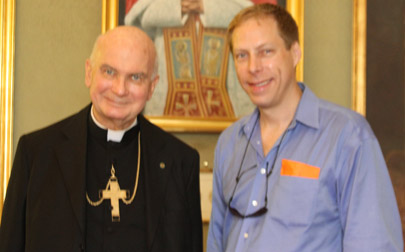
We were giving an all-access pass to the Roman playground on Wednesday. Our seminar group had tickets to the papal audience before a full afternoon of free time to tour the Vatican. Prior to the pope’s audience, I had the honor to spend 30 minutes with Cardinal John Foley, the grandmaster for the Knights of the Holy Sepulchre. I first met the cardinal in 2006 when he was the president of the Pontifical Council for Social Communications. We last met again last year in Jordan immediately after the papal Mass in Amman, Jordan. Certainly one of the warmest prelates I’ve ever had the pleasure to meet, Cardinal Foley always remembered my name despite the years between our meetings.
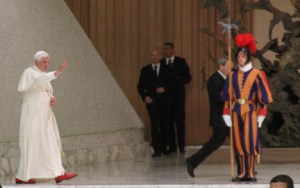
Pope Benedict XVI enters Paul VI Hall

I have attended at least two Wednesday public audiences at the Vatican during the time of John Paul II. The audience we attended was held in the Paul VI Hall, inside the walls of Vatican City. Completed in 1971, the hall holds 6,300 people. I found a seat in the front third of the hall. The Holy Father was wildly greeted as he entered the packed hall around 10:30 am, and even more so when he mentioned the various pilgrimage groups over the course of his talk, which he delivered in at least six languages: English, Italian, French, Spanish, Polish and German. Interestingly, our group was the first one he greeted when he spoke in English. Yay! Yeah, I cheered.

The teaching portion of his talk was on the 12th century saint and mystic, St. Hildegard of Bingen. He also talked about his upcoming visit to the United Kingdom, saying he was looking forward to the visit and to beatifying Cardinal John Henry Newman. Noting the prayers of the faithful for the success of his apostolic journey, the pope said, “Above all, I thank the countless people who have been praying for the success of of the visit and for a great outpouring of God’s grace upon the Church and the people of your nation.”

One of the best parts of papal audiences, generally attended by pilgrims to Rome from around the world, is the reaction of these groups when mentioned by the Holy Father or the priest announcing their presence. Polish seminarians broke into song, Mexican pilgrims waved banners and flags, and American parish groups cheered and stood on their chairs. Every time I attend one of these audiences, I’m reassured that the Church is alive, vibrant and truly catholic, that is, universal.

After a quick lunch in St. Peter’s Square, our group was split in two, for a guided tour of the “scavi,” the excavation site under St. Peter’s Basilica. In the 1930s, the Vatican commissioned archeologists to excavate the site in order to explore the remains of the original basilica, built in the fourth century, and the existence of St. Peter’s remains.

Today’s basilica is right beside what was once known as Nero’s Circus where St. Peter was crucified upside down for teaching the faith. His remains were buried a stone’s throw away in a nearby burial site, apparently between two brick walls in a pagan grave yard. When Constantine converted to Christianity in the fourth century, he decided to build a basilica on Peter’s tomb. I often marvel at the political capital he must have expended in building a church over a grave yard where some very wealthy Romans had buried their ancestors.

The hot, damp tunnels under the basilica led us to the pagan mausoleums, which were very well preserved. Buried in the fourth century to make way for the basilica, mosaics, paintings, urns and sarcophagi appeared much as they did 1500 years ago. One story above the tombs, were some remnants of Constantine’s basilica. Finally, the last stop of the scavi tour brought us to a room where we could see, behind glass and inside one of the original altars of the first basilica, an ancient box that holds St. Peter’s relics. I paused to remember my family, friends and their special intentions in a quick prayer to the first pope.

It was my third scavi tour. It never gets old … and not just because it is old (ha ha), but because it’s one of the most profound and tangible aspects of Christian faith. The man who walked on water, who spent three years with Jesus Christ, the man who denied him three times, and the man who was given the Keys to the Kingdom was right here with me. Our faith is tangible, it is historic and it is real.
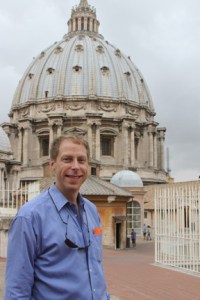
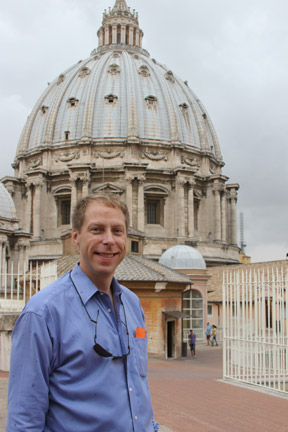
Atop St Peter's Basilica

After viewing the tombs of the popes — including that of Pope John Paul II — below the basilica’s main floor, a few of us found our way from the scavi tour under the basilica to the cupola, nearly 450 feet (135 m) above the square below. We stood in the queue for about 20 minutes before dropping 7 euro to take the elevator to the basilica’s rooftop. From there, it was 320 windy, narrow stairs to the cupola. This was my third time on top of the famous basilica. It was windy, threatening to rain, but incredibly still crowded. The view of Vatican City and all of Rome is unbelievable.

We tried to visit the basilica’s adoration chapel after bringing ourselves to ground level. The priest had just begun benediction, so we were turned away by the guard at the door. No matter, we wandered about and found the glass coffins of a 17th century pope and that of Pope John XXIII, who died in 1963. About 10 years ago, his exhumed body was found to be partially in corrupt and placed in the upper floor of the basilica. His face is covered with a thin protective layer of wax.
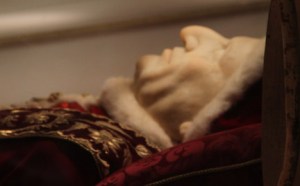
Pope John XXIII

We had to hurry back to the university, a 30 minute walk from the Vatican, for a fascinating session on canonical trials in the church by Monsignor Charles Scicluna, who works at the Congregation for the Doctrine of the Faith.

I don’t know if all of my readers find Rome — and this kind of in-depth exploration of the Catholic Church — as captivating as I do. I expect that if you’re reading this final paragraph, you do too!

In the coming days, we’ll learn more about the Church’s position on stem cell research, the Pope’s upcoming trip to the UK next week, the Vatican’s use of new technology, and we’ll wrap up on Sunday with a trip to Subiaco, the site of St. Benedict’s final monastery. I fully expect it will be as fascinating as what I’ve already experienced in my Roman playground. Stay tuned for my next blog post!

Fighting the good fight

2 Sep

SEPTEMBER 2, 2010 — The world is certainly a different place than when I attended college in the late 1980s. I studied at two secular schools and proudly lived my faith, joining Catholic clubs and attending Mass as often as possible on campus.

I can vividly remember talking to the Protestant students at the Campus Crusade for Christ table during orientation before later joining Catholic Christian Outreach, a dynamic movement of Catholic university students.

I encountered little hostility from students or professors. However, hostility toward Christians on secular college campuses has grown rapidly. A 2008 study by the Higher Education Research Institute at UCLA shows that college students tend to shift to more liberal positions on issues like gay marriage, abortion and religion from the time they are freshmen through their junior year.

That shift — facilitated by both peers and professors — was evident this summer as a number of students and professors who tried to live their faith on campuses across the country were summarily shut down.

Case in point: Dr. Kenneth Howell, a devout Catholic teaching at the University of Illinois, was terminated for simply answering a student’s email on what the Church teaches about homosexuality. Inexplicably, the firing was prompted by an anonymous email.

David French, senior counsel at the Alliance Defense Fund, told me that mainstream thinking in the academy is that traditional Judeo-Christian morality has no place in higher education. No debate. No discussion.

So what’s a Christian student to do when standing up for what you believe can get you expelled? You can always keep your faith to yourself. But Jesus says we’re not to keep our light under a bushel basket (Mt 5:15) and St. Paul tells us that we must fight to win (1 Cor 9:24-27).

We’re called to be a light to those who walk in darkness. Our example, our courage and the truth — even if it’s shut out of the debate — will eventually win out. But if we walk away and leave those who don’t know Christ to their own devices, their future (and their eternity) could be awfully grim.

In Dr. Howell’s case, he kept the faith. Within days, students — Christian and atheist alike — and the community rallied to his defense demanding academic freedom and a little common sense. The result? He got his job back.

We shouldn’t be surprised. The UCLA study I mentioned notes that despite the secularization of our public colleges and universities, 79% of college freshmen believe in God, and 69% pray and find strength, support and guidance in their religious beliefs.

The truth is that the vast majority of Americans outside the major urban centers are not sold on the secular left’s agenda to wean America of its religious heritage. We should never be afraid to stand up for the truth. Besides, God is on our side!

Patrick Novecosky is the founder and editor of The Praetorium.

Humility, humility, humility

16 Jul

JULY 16, 2010Someone once asked St. Bernard of Clairvaux what the three most important virtues are. He famously replied, “Humility, humility and humility.” Anyone who has studied the lives of the saints will tell you that this 12th century saint had it right. Humility is a prerequisite for sanctity.

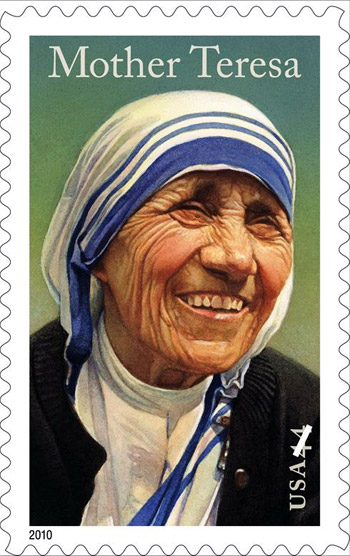
USPS will issue this stamp on the centenary of Mother Teresa's birth, Aug. 26, 2010.

Prior to Mother Teresa’s death in 1997, people called her a living saint precisely because she lived humility. She wore the same old, patched sandals until they fell apart. Everything she owned fit into a small bag, yet she built one of the largest, most vibrant religious orders of the 20th century.

As we close in on what would have been the famous nun’s 100th birthday on Aug. 26, we take a look in this issue at how she touched the lives of four Legatus members. (Click here for a related story.) On her birthday, the U.S. Postal Service will honor the Nobel laureate with a stamp bearing her image, and the Catholic League is working to have the Empire State Building lit up with blue and white lights in her honor. (Thus far, the owner of the building has refused; a petition and protest are in the works.)

Those who have read about the famous nun’s life often ponder how a diminutive little woman from Albania came to build an order of 4,500 nuns in 133 countries in less than half a century. There is no question that Mother Teresa’s secret is found in her total surrender to the will of God. Secondly, humility.

Legatus Magazine‘s July/August cover story relates how seminarian Christopher Nalty once rolled his eyes after hearing Mother give her “stump speech” to visitors on how many houses the order had. She wasted no time in setting the future priest straight.

“She turned to me and walked toward me, grabbed my shirt and said, ‘Look at me. I couldn’t do that. God did that,’” Nalty explained. “That’s the point I hadn’t gotten all summer! She wasn’t bragging. She was saying, ‘Look at what God did.’”

I didn’t have the opportunity to meet Mother Teresa myself, but a few months after her death, I had a sit-down interview with Sr. Nirmala Joshi, her successor as superior of the Missionaries of Charity. I asked her about Mother’s legacy, her work and Divine Mercy.

She told me that Mother learned about the Divine Mercy message and devotion shortly before her death. Then, just nine days after she died, the sisters began spontaneously praying the Chaplet at Mother’s tomb. “She did not know the Chaplet,” Sr. Nirmala said. “Her main devotion was the rosary. But her life was Divine Mercy.”

The one thing that I’ll never forget about that encounter with Sr. Nirmala was that the answers she gave were exactly what I’d expect to hear from Mother Teresa. In all things, she gave thanks to God, taking no credit for her work. In fact, Mother Teresa said she hand-picked her successor because she was among the least qualified. In that way, any success could only be attributed to God. Lesson learned.

Patrick Novecosky is the founder and editor of Legatus Magazine. This article appeared in the July/August 2010 issue of Legatus Magazine. Reposted with permission.

Design a site like this with WordPress.com
Get started