Obama and the new holocaust

7 Jun

JUNE 7, 2009 — Piles of shoes several feet high filled a glassed-in room. Next to it was another room filled with eyeglasses. Then I saw the room filled with human hair—clumps of hair and even long braided hair which had been shaved off of women destined for the gas chambers. Despite the fact that it was over 50 years old, the braid looked freshly cut. Coming face-to-face with the remnants of horror and mass murder is life changing. The camp commandant at Auschwitz testified at the Nuremberg Trials that up to 3 million people died there. The Auschwitz-Birkenau State Museum has revised this figure to 1.1 million.

My 1997 visit to the Nazis’ largest death camp in southern Poland is still fresh in my mind after more than 12 years. The memories came rushing back after hearing of news reports of President Obama’s June 5 visit to the Buchenwald concentration camp in Germany.

Buchenwald is a place “where people were deemed inhuman because of their differences,” Obama said. “These sights have not lost their horror with the passage of time.” Even though more than 50 years have passed, he said, “our grief and our outrage over what happened have not diminished. I will not forget what I have seen here today.”

The main gate at the Auschwitz death camp

The main gate at the Auschwitz death camp

He’s right. My experience left me with the same feeling. I left changed forever after seeing the ovens that the Nazis used to cremate the remains and erase their crimes. It was almost surreal to walk under Auschwitz’s iron gate crowned with the infamous motto “Arbeit macht frei” — work brings freedom — an obvious lie … and everyone involved knew it.

There are no words to describe the horror of standing in a place where millions of innocent human lives were so callously extinguished. It’s important that the world never forget the holocaust in order that it may never happen again. Civilized human beings should never permit the wholesale slaughter of a race of people under any circumstances.

If you’ve ever stood in front of an abortion mill and recognized what goes on inside, the feeling of horror is no different than that of visiting a Nazi death camp. There’s no question that the Nazis were good at killing. The abortion industry, however, has perfected it. Their efficiency would have left even the most hardened Nazi in awe. Hitler himself would be proud. Every state in the union has “clinics” where women can come to have their child exterminated. There were over 1 million abortions in the U.S. last year — 50 million dead since the U.S. Supreme Court legalized the new holocaust in 1973.

Since taking office in January, Obama has consistently made pro-abortion appointments to key administration positions like the head of Health and Human Services, Kathleen Sebelius. One of his first acts was to reverse the Mexico City Policy, sending millions of dollars to fund abortions overseas. Obama issued an executive order on Jan. 22 reversing the Bush administration policy that bans the use of federal dollars by non-governmental organizations that discuss or provide abortions outside of the United States.

Life is good. Really good.

Life is good. Really good.

Interestingly, despite his popularity, Obama has shown himself to be incredibly out of touch with the American public. A spate of polls in May revealed that the majority of Americans are against abortion on demand. A Gallup poll, conducted from May 7-10, found that about 51% of Americans call themselves “pro-life” and 42% “pro-choice.” This is the first time a majority of U.S. adults have identified themselves as pro-life since Gallup began asking that question in 1995.

If this trend continues, it’s conceivable that within my lifetime, a future president of the United States will make a pilgrimage at a former abortion mill, lay a wreath and echo Obama’s very words: “I will not forget what I have seen here today. These sights have not lost their horror over time.”

Let’s hope. And let’s pray that this comes to pass.

Patrick Novecosky is the founder and editor of The Praetorium.

Pilgrim of peace

18 May

MAY 18, 2009 — Pope Benedict XVI stepped into the fray of Middle East politics by endorsing a Palestinian state during his recent pilgrimage to the Holy Land.

During his May 15 farewell speech at the Tel Aviv airport, the Pope stressed the need for universal recognition of Israel’s right to exist and the Palestinians’ “right to a sovereign independent homeland.

“Let the two-state solution become a reality,” the Holy Father said, noting that six decades of bloodshed in the Holy Land has distressed him.

“No more bloodshed! No more fighting! No more terrorism! No more war!” he pleaded. “Instead, let us break the vicious circle of violence. Let there be lasting peace based on justice; let there be genuine reconciliation and healing.”

A model for peace

The impassioned speech was one of the many highlights of Pope Benedict’s May 8-15 pilgrimage to the Holy Land, which began with a four-day stop in Jordan. In many ways, his visit mirrored that of Pope John Paul II, who visited Jordan and Israel in 2000.

Pope Benedict began his journey with a stop at Jordan’s Mount Nebo, where tradition says Moses gazed out upon the Promised Land before his death.

“It is appropriate that my pilgrimage should begin on this mountain.” This holy place, he said, should remind all Christians to “undertake a daily exodus from sin and slavery to life and freedom.”

The Pope visited a mosque in the Jordanian capital of Amman before participating in vespers at St. George Melkite Cathedral. It was inspiring to see the Jordanian Christians’ affection for the Holy Father. They shouted, waved flags and sang when he entered the cathedral. The applause was almost deafening.

More than 30% of Jordan’s 109,000 Catholics piled into Amman International Stadium on May 10 for the papal Mass. The youth presence was impressive. Thousands of young people cheered and sang long before the Holy Father’s arrival. A song written especially for the papal visit — “Benvenuto Benedetto in Jordania” (Welcome to Jordan, Benedict in Italian) — rang through the crowd dozens of times throughout the morning.

In his homily, the Pope exhorted the Middle Eastern Christians to stay in the Holy Land and give testimony to Jesus in this conflict-plagued region.

“Fidelity to your Christian roots, fidelity to the Church’s mission in the Holy Land demands of each of you a particular kind of courage: the courage of conviction, born of personal faith, not mere social convention or family tradition; the courage to engage in dialogue and to work side by side with other Christians in the service of the Gospel.”

In his farewell address in Amman on May 11, the Holy Father hailed Jordan as a model for peace and religious tolerance in the Middle East.

“I would like to encourage all Jordanians, whether Christian or Muslim, to build on the firm foundations of religious tolerance that enable the members of different communities to live together in peace and mutual respect,” he said.

Jordan’s King Abdullah II has gone to great lengths to foster interreligious dialogue, the Pope said. “This spirit of openness … has contributed to Jordan’s far-sighted political initiatives to build peace throughout the Middle East.”

Two-state solution

The Holy Father wasted no time getting down to business after touching down in Israel. He called for a Palestinian state in his first speech. He went on to meet with other religious leaders, visit the Church of the Nativity in Bethlehem and the Church of the Holy Sepulchre in Jerusalem, and celebrate Mass in Nazareth for about 50,000 pilgrims.

Together with Israeli president Shimon Peres, the Pope planted an olive tree at the presidential palace as a sign of the close relationship between Jews and Christians. He called this gesture, along with meeting with Holocaust survivors at the Yad Vashem memorial, the most memorable of his pilgrimage to Israel.

“So many Jews … were brutally exterminated under a godless regime that propagated an ideology of anti-Semitism and hatred,” he said. “That appalling chapter of history must never be forgotten or denied.”

The Holy Father also met with Palestinian leader Mahmoud Abbas in the Palestinian territories. He called the security wall separating Palestinians from Israelis “one of the saddest sights for me during my visit to these lands.” Acknowledging how hard it will be to achieve lasting peace, the Pope said said he had prayed “for a future in which the peoples of the Holy Land can live together in peace and harmony without the need for such instruments of security and separation.”

Patrick Novecosky is the editor of Legatus Magazine and the founder of The Praetorium. This article was published in the June 2009 issue of Legatus Magazine. He was in Jordan for Pope Benedict’s four-day visit to that country.

The Dead Sea, the Red Sea & the desert

14 May

MAY 14, 2009 — After spending the last three days in the rugged Jordanian outback, one thing is clear: My people (fair skinned Germanic types) were not made for the desert. Even though I live in Florida where the sun can bake anyone to a crisp, the hot, dry desert is no place for blondes … unless you’re T.E. Lawrence (aka Lawrence of Arabia). But even he went home eventually.

If you’ve been following this blog, you’ll note that Pope Benedict left for Israel on Monday. I stayed behind to continue a press tour of Jordan sponsored by the Jordanian Tourism Board (JTB), accompanied by a four other American journalists, a JPB rep, and a local guide (Ibrahim) who could easily be mistaken for a wise-cracking American. He says he once lived in Pittsburgh, but who’s to know for sure.

Monday, May 11

Our local guides at Ajloun

Our local guides at Ajloun

After the Pope’s departure early this morning, we headed north to Ajloun . We visited a local business run by local women which produces hand-made high end soaps before setting out to explore more rugged terrain.

Monk caves near Ajloun, Jordan

Monk caves near Ajloun, Jordan

We saw caves once occupied by monks, the ruins of a 6th century church dedicated to the Old Testament prophet Elijah. It was in ruins, but contained an empty underground crypt and some newly discovered mosaics that had been hidden for centuries.

Arab entertainers at the Jerash Roman ruins

Arab entertainers at the Jerash Roman ruins

We stopped for lunch in Jerash — a city which boasts an unbroken chain of human occupation dating back more than 6,500 years.

The ampitheater, Jerash ruins

The amphitheater, Jerash ruins

According to Ibrahim, our sagacious guide, it contains the best preserved Roman ruins outside of Rome itself. After spending a couple hours exploring the fallen city, I think I believe him.

Before going to bed, I did a quick calculation and figured out that it was about 10 am back in Saskatchewan, so I called my Dad to wish him a happy 72nd birthday. He was surprised to hear from me. Thankfully, I was able to call via the Internet using a headset for only 2.1 cents/minute. Skype rocks!

Tuesday, May 12

Early this morning, we checked out of the hotel in Amman and drove down. Literally. By mid-morning, we were at the Dead Sea, elevation nearly 1,400 feet below sea level. It’s the lowest spot on earth (with air, of course). At 1,240 ft deep, it’s the deepest hypersaline lake in the world. JTB arranged for us to take use the luxurious facilities at the Mövenpick — one of the high-end resorts on the Jordanian side of the Sea.

A few of us wandered down to the beach to check out the salty waters and the world-famous Dead Sea mud, which is apparently pure gold for your skin. Black gold, that is. My official photographer, Greg Tarczynski, has some pictures of me covered in the stuff. I’ll post them soon, so come back to this entry in a week or so. We packed up after lunch and drove a few hours south to the Red Sea port of Aqaba before the sun set on another beautiful day in Jordan.

Wednesday, May 13

The Treasury, Petra

The Treasury, Petra

The Treasury, Petra

The Treasury, Petra

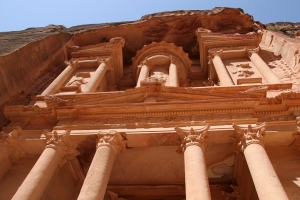
The most physically challenging day of our tour began at the 1st century BC city of Petra, about 75 miles northeast of Aqaba. It’s a vast, unique city, carved into the sheer rock face by the Nabataeans, an industrious Arab people who settled here more than 2,000 years ago, turning it into an important junction for the silk, spice, and other trade routes that linked China, India, and southern Arabia with Egypt, Syria, Greece, and Rome.

I took a lot of pictures, but they don’t do the site justice. Among the most impressive was The Treasury, which was featured in Indiana Jones and the Last Crusade. At 100 ft wide and 145 ft high, it dwarfs everything around it. Called Al Khazneh by the Arabs, it was carved in the early 1st century as the tomb of an important Nabataean king.

At the Treasury, Petra, attempting to be Solomon

At the Treasury, Petra, attempting to be Solomon

The next adventure on the trail was not for the faint of heart or weary of feet. Petra’s largest monument (165 ft high and 150 ft wide), the Monastery or Ad-Deir in Arabic is an hour’s hike (800-900 steps) up a rugged trail covered with loose rock. It sits 3,750 above sea level. The climb was worth it. Dating from the 1st century BC, it was most likely a Nabataean temple. However, apparently Christian monks lived there during the Roman era.

The massive "Monastery" is impressive at 3,750 above sea level

The massive "Monastery" is impressive at 3,750 above sea level

Atop a cliff overlooking The Monastery, Petra

Atop a cliff overlooking The Monastery, Petra

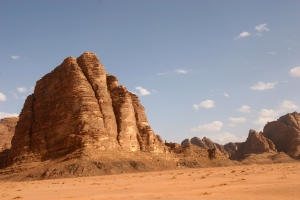
We weary hikers felt like we were on a movie set all day. In the afternoon, we shifted from Indiana Jones to the Lawrence of Arabia. Jordan’s most famous desert, Wadi Rum, was the setting for the classic 1962 Lawrence Oliver movie about T.E. Lawrence who called the area “vast, echoing and god-like.” The name means high (rum) valley (wadi).

The Seven Pillars of Wisdom, Wadi Rum

The Seven Pillars of Wisdom, Wadi Rum

Our intepid group loaded onto the back of a canopy-covered 4X4 pickup truck and headed out from the visitors center to the desert. A convoy of 1970s and ’80s modified 4X4s followed with dozens of tourists to explore the expansive sea of rocky peaks. Wadi Rum is a maze of rock formations and hills that rise up from the desert floor up to 5,800 ft. One of the most impressive is called The Seven Pillars of Wisdom.

At a bedouin camp, Wadi Rum

At a bedouin camp, Wadi Rum

I purchased a keffiyeh — official Arabic headgear — a black and white scarf which, when properly tied, protects your head, neck, and face from sun and sand. While it’s not approved for use in banks or airports, it sure did the trick for me with the wind and sand blowing on us as we drove through the desert.

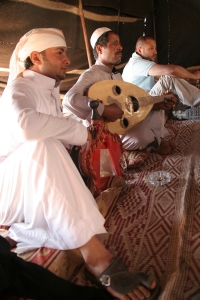
We stopped at a bedouin (nomad) rest stop in the desert where they had various items for sale. In a separate tent, they offered free sweet hot tea. A couple men played a cool-sounding instrument. Check out the photo, and if you know what it’s called, let me know. One of our crew, Julie Rattey from Catholic Digest, bravely climbed aboard a camel. I was too busy with the tea and petroglyphs 100 yards away to take a turn.

Our ride, Wadi Rum

Our ride, Wadi Rum

We parked just a stone’s throw from a dry lakebed and a bedouin camp where some many tourists camped for the night.

The sun sets at Wadi Rum

The sun sets at Wadi Rum

By the time the sun was ready to drop over the horizon, about 50 people were watching in awe as it dropped below the horizon around 7:30 pm. The reddish orange glow in the sky almost matched my reddened cheeks and fried nose as another blessed day drew to a close in Jordan.

Thursday, May 14

After a grueling, sun-drenched day in the desert, it was time for a leisurely day … on the water. We joined a crew of about 20 Brazilian-Peruvian journalists who were on another JTB press tour. Most of them had also covered the papal visit to Jordan and had morphed into travel journalists … like yours truly.

We boarded a glass-bottomed boat and pushed off into the Gulf of Aqaba on the Red Sea around 11:30 am. Within 30 minutes, we were sitting over blue, yellow and reddish coral (from which the Red Sea gets its name). Five minutes later, we floated over a shipwreck which had sprouted coral and other sea life. Small fish swam along under us. Apparently there are few large sea creatures in the Gulf of Aqaba. From our furthest point out, we could see four countries — Jordan, Israel, Egypt and Saudi Arabia. I felt like a world traveler just sitting there out in the Gulf!

A few Brazilians rented scuba equipment and a dozen of us jumped in for a little snorkeling in the frigid water. The crew put out a spread of salads, hummus, and grilled chicken kebabs and sausage kebabs. We docked and by mid-afternoon, we were on terra firma once again. It’s a rough life. Perhaps one day I will also convert into a travel journalist … but only if I can take my wife and kids with me!

Patrick Novecosky is the founder and editor of The Praetorium.

Cartoonist draws on faith

14 May
Pulitzer Prize-winning cartoonist Steve Breen

Pulitzer Prize-winning cartoonist Steve Breen

MAY 14, 2009 — Steve Breen and his wife, Cathy, had just finished a 54-day novena to St. Joseph when they got the news that he had won his second Pulitzer Prize.

Breen’s cartoons are nationally syndicated and regularly appear in The New York Times, USA Today, Newsweek and U.S. News & World Report. Pulitzer judges picked Breen “for his agile use of a classic style to produce wide-ranging cartoons that engage readers with power, clarity and humor.”

A lifelong Catholic, born in 1970, the nationally syndicated editorial cartoonist regularly draws cartoons celebrating his faith. His Easter cartoon this year, for example, showed a silhouetted cross at sunrise on Calvary with the caption: “Sustainable power source.”

He spoke with Register correspondent Patrick Novecosky from his office at The San Diego Union-Tribune.

Was the Catholic faith central to your growing up in the Breen house?

Yes, it was. I had a strong Catholic upbringing. I grew up in Huntington Beach, Calif., as the second of eight children. We were your church-every-Sunday, fast-at-Lent, family-Rosary Catholics. We said grace before every meal, prayers before bed, and have a great loving mother who read to us about the saints and taught us the faith.

I went to Catholic elementary school, but my formation there was a little wishy-washy. It wasn’t until I got into college that I got stronger into my faith. That seems counterintuitive because that’s where a lot of young Catholics seem to drift away. But for some reason, I started to get more and more into my faith when I was going to the University of California, Riverside. I went to confession regularly, the Newman Center for Mass, and visited churches in the area.

My cousin was in the seminary, and we would have great theological discussions. So, I grew tremendously in my faith in my early 20s. One of the reasons may have been all the prayers I was saying to find a job and a spouse. Those prayers lifted me to a higher spiritual plateau. I did more spiritual reading, like Introduction to the Devout Life, and I’d defend the faith in discussions with my friends. I’ve always been a proud Catholic and stood out from my peers because of my faith. Let’s face it: Southern California isn’t known as a bastion of traditional Catholicism.

Did you draw a lot as a kid?

Yes, ever since I was 6 or so. As I got into elementary school, I started drawing more for my friends and developing a reputation as being a good artist. I loved the attention. I thought it was fabulous to have something that was special to me. My gift for drawing helped set me apart, and it’s really nice for a young person to have that. It gives them confidence and self-esteem.

I was always able to draw Bugs Bunny and Mickey Mouse. Then, as I got into junior high, did more Mad magazine stuff, cartoons of friends and teachers; I created my own cartoon strips — that kind of stuff. I loved to entertain back then and make my friends laugh.

You were planning on becoming a high school history teacher. How did you get started as a cartoonist?

At age 19, I knew I wanted to be a cartoonist. I was drawing editorial cartoons for my college newspaper at the time. One of my first ones ran in Newsweek, and that really put the wind in my sails and made me determined to try it as a career. I focused on it like a laser beam, but I couldn’t find a job. There was a recession going on in the early ’90s, so I spent another couple years in college working on a teaching credential. All the while, I was sending out my cartoons to newspapers all over North America that did not have a cartoonist. Literally everywhere, from Hawaii to Maine.

Finally, the Asbury Park Press called me, and they said, “We like your stuff. Can we use one of these?” I would boldly do cartoons on local issues or politicians, so I did some New Jersey issues. They ran a few, which developed into “Would you like to come out here and do an internship?” That developed into a full-time job doing cartoons one day a week and doing pagination the rest of the time. After a year or two, I became a full-time cartoonist. I met my wife in New Jersey, so it turned out to be a really good thing.

How does your faith inform how you perceive the news and interpret that in your cartoons?

Cartooning is all about comforting the afflicted and afflicting the comfortable. It’s sticking up for the little guy, and that is one of the basic principles of Christianity. I try to show a respect for life in all my work. I’m consistently pro-life on everything from the death penalty to abortion to stem cells and euthanasia — even to being in favor of gun control and [opposing] unjust wars. I think that’s a consistent theme and a Catholic theme.

You dedicated your recent Pulitzer win to your fellow cartoonists across the country who have been laid off. You also admitted that, despite your success, your own position isn’t guaranteed. How does your faith sustain you in these tough times?

God will provide for those who are faithful. He may not always give you what you want, but he will give you what you need. Cathy and I recently finished a 54-day novena to St. Joseph, and right on the heels of it, I won three national awards, including the Pulitzer, so you can draw your own conclusions. Prayer really works, and it’s something that will sustain you — a sustainable power source.

Your editor said, “Steve’s talent lies in his ability to poke fun without getting personal.” Is it a challenge to stay fair and honest in your work without being mean-spirited?

It is, because sometimes you have to pull yourself back, take a pause, look at the cartoon, and ask yourself if it’s fair. Sometimes I’ll look at it and say, “No, it’s not fair. I shouldn’t say this or I should adjust that.” That has happened. Sometimes my editor will point it out to me. If you’re just out for blood or being mean-spirited in the cartoon, you can lose people — especially if you do it on a consistent basis. You’ll come to be known as the cartoonist who is nasty. It’s not that I want to be liked; I don’t want people to write me off as being too harsh and nasty. If I could tone the cartoon down and use some other device, I can reach more people sometimes.

You also created the comic strip “Grand Avenue.”

Yeah, I started it in 1999. I’d always wanted to do a comic strip with kids in it. Kids are so fun, and there’s so much material. But there have already been strips with kids, so I thought, “What if I add something different, like they’re being raised by their grandmother? There are a lot of older readers who might appreciate it.” That’s how it came to be. It’s been a lot of fun. A few years ago, I took in a partner, so I now draw it with Mike Thompson of Detroit. We’re now in 150 newspapers.

You and your wife have four kids, and you’ve written a few children’s books. Tell me about that.

Right. I’ve done two books. The first was Stick in 2007, then in ’08, I had Violet the Pilot. And this fall I have a new book coming out called The Secret of Santa’s Island. I’m a huge fan of Christmas and have always wanted to do a Christmas book. I also love the Charlie Brown Christmas special. So I show the elves watching the Charlie Brown Christmas show on one of the pages.

Getting back to my family, Cathy is from a family of 11 kids. Her dad is Bud McFarlane Sr., the Catholic evangelist. They are a great supportive family. We were married in 1998 and have four kids. Thomas is 10; Patrick is 7, Jack is 4 and Jane is 1.

The three oldest love to draw and color. But with the state of the newspaper industry, I’m telling them not to consider a career in journalism. I’m sure they’ll be great Catholic artists. They might find jobs in Catholic web design or something like that.

Patrick Novecosky is the founder and editor of The Praetorium. This article appeared in the May 17-23, 2009, issue of the National Catholic Register. Reprinted with permission.

The papal drive-by

12 May
The site on the Jordan where Christ was baptized. (Patrick Novecosky photo)

The site on the Jordan where Christ was baptized. (Patrick Novecosky photo)

MAY 12, 2009 — As the pea gravel crunched beneath my feet, I couldn’t help but think of the Last Supper where Jesus washed the feet of his disciples. The chalky dust not only covered my shoes, but permeated the air as we walked the path to the spot where tradition says Jesus was baptized in the Jordan River.

Just an hour outside of Amman, Jordan, we were about two hours ahead of Pope Benedict’s arrival at the site, part of his four-day visit to the country. It was mid-afternoon on Sunday as our bus dropped off the crush of media covering the Pope’s visit to the Holy Land. Photographers and reporters from around the world were packed into three buses on this hot and dry day. Site staff gave us the option of waiting for the Pope in the parking lot where he would be greeted by Jordan’s King Abdullah II and Queen Rania — or we could walk a quarter mile down the pea gravel path to the Baptism Site. Most everyone chose the latter.

Waiting for the Pope at the baptism site.

Waiting for the Pope at the baptism site.

Dozens of us scoped out the best vantage point to view (and photograph) the Holy Father, who was to stop at a platform overlooking the spot designated as the place where John the Baptist christened Our Lord in the muddy waters of the Jordan. It wasn’t impressive. Scraggly bushes surrounded the area which seemed to be fed by a tributary from the river itself. However, archeological experts have determined that early Christians built a church to commemorate the spot as the place of Christ’s baptism. When the area flooded, they came back and built again. That resolve has convinced many that this was the biblical site of Bethany Beyond the Jordan described in John 1:28 and John 10:40.

The Holy Father with the King and Queen of Jordan. (Patrick Novecosky photo)

The Holy Father with the King and Queen of Jordan. (Patrick Novecosky photo)

I found a perfect spot to await the Holy Father, only 20 feet from the platform. After chatting with colleagues for about 90 minutes, a convoy of eight-passenger golf carts arrived with security personnel, followed by the Holy Father, the King, Queen, Prince Ghazi among others. The Holy Father’s vehicle stopped for five minutes as a site expert described the scene for the Pope. But rather than disembarking to take in the site from the viewing platform as planned, the papal cart spend on down the path to an awaiting crowd of about 800 pilgrims.

Greg Tarczynski, a well-known photographer for Catholic and other media outlets, had parked himself on the muddy river bank for nearly two hours to get a picture that was not to be. We all scrambled down the path to the stage where the Pope was to bless the cornerstones for two churches planned for the Baptism site — a Latin-rite church already under construction and a Melkite house of worship. However, the military security (who seem just as confused by the papal entourage’s change of plans) held us back. We found out later that we were detained until the royal entourage could leave the area.

The papal entourage.  (Patrick Novecosky photo)

The papal entourage. (Patrick Novecosky photo)

We got to the platform just as the ceremony got under way. I stood on a chair as close as possible to the stage and got a descent shot of the Pope blessing the cornerstones. After the papal convoy departed, we were blessed with an incredible view of the sun setting in the west, finally dipping below the horizon in the land where Jesus walked. A fitting end to a day I won’t soon forget.

Pope Benedict blesses two cornerstones.  (Patrick Novecosky photo)

Pope Benedict blesses two cornerstones. (Patrick Novecosky photo)

Kresta in the Afternoon

11 May

MAY 11, 2009 — I had the honor of being the final guest on Kresta in the Afternoon this afternoon live (via Skype) from Amman, Jordan. The daily program is produced by Ave Maria Radio and heard around the world on EWTN Radio and Sirius/XM Satellite Radio.

Host Al Kresta asked me about my time traveling with Pope Benedict XVI during his pastoral visit to Jordan. My four blog posts (1, 2, 3, 4) about the visit have been read by people from around the world. Al asked me about how well the Pope’s visit has been received among the predominantly Muslim nation. We also talked about the cultural differences between Jordan and the United States.

Click here to listen. (Opens in new window. 11:47 minutes).

The Good Shepherd

11 May

MAY 11, 2009 — It’s amazing to think that in a country with only 109,000 Catholics, nearly a third of them piled into Amman’s International Stadium on Sunday for an open-air papal Mass. After departing the media center at 6:00 am, I expected the horde of media (yours truly among them) would be among the first to arrive, but a few hundred hearty souls were already in the stands when we pulled shortly after 6:30.

Thousands await Pope Benedict XVI at Amman International Stadium on Sunday, May 10. (Patrick Novecosky photo)

Thousands await Pope Benedict XVI at Amman International Stadium on Sunday, May 10. (Patrick Novecosky photo)

I spent a few hours talking to media from around the world, my colleagues from America, and a few Jordanians. Organizers had tapped the Jordanian Scouts and Girl Guides to help with logistics and crowd control. At least 100 teens dressed in their blue uniforms answered pilgrims’ questions and helped form a human barrier between the congregation and the yellow and white sanctuary on the east side of the stadium. The youth presence at the Mass was impressive. Hundreds of young people cheered and sang long before the Holy Father’s arrival. A song written especially for the papal visit — “Benvenuto Benedetto” (Welcome, Benedict in Italian) — rang through the crowd dozens of times throughout the morning.

Pope Benedict XVI enters Amman International Stadium in the Popemobile on Sunday, May 10. (Patrick Novecosky photo)

Pope Benedict XVI enters Amman International Stadium in the Popemobile on Sunday, May 10. (Patrick Novecosky photo)

True to form, the Holy Father arrived in the Popemobile punctually around 9:30, circling the stadium to the roar of about 30,000 enthusiastic souls. The yellow and white themed sanctuary was decorated with a large image of Christ, the Good Shepherd, because the Eastern Church was celebrating the fourth Week of Easter and Good Shepherd Sunday. They marked Easter one week later than in the West. An image of Mary and John the Baptist, patron of Jordan, also adorned the sanctuary.

Jordanian-born Archbishop Fouad Twal, patriarch of Jerusalem, warmly welcomed the Pope in English. He joked that the Church in Jordan is having a “vocations crisis” because its seminary is bursting at the seams and is struggling to find housing for the men eager to enter the priesthood.

Pope Benedict XVI processes to the altar at the beginning of an open air Mass at Amman International Stadium on Sunday, May 10. (Patrick Novecosky photo)

Pope Benedict XVI processes to the altar at the beginning of an open air Mass at Amman International Stadium on Sunday, May 10. (Patrick Novecosky photo)

In his homily, the Pope exhorted the Middle Eastern Christians to stay in the Holy Land and give testimony to Jesus in this region so plagued by conflict.

“Fidelity to your Christian roots, fidelity to the Church’s mission in the Holy Land, demands of each of you a particular kind of courage: the courage of conviction, born of personal faith, not mere social convention or family tradition; the courage to engage in dialogue and to work side by side with other Christians in the service of the Gospel and solidarity with the poor, the displaced, and the victims of profound human tragedies,” he said.

An Iraqi Chaldean Catholic girl awaits her first Holy Communion from Pope Benedict XVI at Amman International Stadium on Sunday, May 10. (Patrick Novecosky photo)

An Iraqi Chaldean Catholic girl awaits her first Holy Communion from Pope Benedict XVI at Amman International Stadium on Sunday, May 10. (Patrick Novecosky photo)

The Mass concluded with 40 Iraqi Chaldean children receiving their first Holy Communion. Cardinal Emmanuel III Delly, patriarch of Baghdad, was among the dozens of priests and bishops concelebrating with the Holy Father.

After Mass, I talked to an American journalist who writes for the Jordan Times. The reporter was impressed with the high energy of the Mass — a rarity in this predominantly Muslim country. It was truly a celebration of Jordanian Catholicism, leaving enduring memories for thousands of the country’s faithful.

Design a site like this with WordPress.com
Get started