Kresta in the Afternoon

15 Sep

SEPTEMBER 15, 2010 — I had the honor of being the final guest on Kresta in the Afternoon yesterday. The daily program is produced byAve Maria Radio and heard around the world on EWTN Radio and Sirius/XM Satellite Radio.

Host Al Kresta asked me about the week-long seminar for journalists from around the world I attended in Rome last week, from Sept. 6-12. I was among 27 journalists from eight nations who attended The Church Up Close: Covering Catholicism in the Age of Benedict XVI, organized by the School of Church at the Pontifical University of the Holy Cross.

My three blog posts (1, 2, 3) about the seminar have been read by people from around the world. Al asked me about why secular journalists don’t understand religion. We also delved into the various sessions the seminar offered, including a visit to the Vatican Press Office, the Congregation for the Doctrine of the Faith and dozens of seminars over the course of the week.

Click here to listen (Opens in a new window. 13:57 minutes).

The Church up close

14 Sep

SEPTEMBER 14, 2010 — I’ve been a Catholic journalist for more than 18 years. I’ve worked for an archdiocese, a weekly Catholic newspaper, a Catholic university, a religious order, and a few Catholic magazines—not to mention freelancing for a potpourri of national Catholic publications. So I sometimes feel like I’ve seen it all and heard it all. Then I came to Rome for a conference for journalists who cover the Catholic Church. The truth is, I’ve just scraped the surface. The universal Church is as diverse as its 1.1 billion adherents, yet we are one body in Christ.

This is my second post from Rome. I’ve just wrapped up a seminar—The Church Up Close: Covering Catholicism in the Age of Benedict XVI—at the Pontifical University of the Holy Cross (Santa Croce). Attending the seminar, organized by the university’s School of Church Communications, were 27 journalists from eight nations. Many of our speakers in the last half of the seminar asked that we keep their comments off the record, so this post doesn’t reflect the full scope of what we experienced, but it reflects the tenor of the class. Our speakers discussed everything from economic justice and the Church in Africa to Pope Pius XII and how the Church communicates in the digital age. Although I don’t expect to report on all of these issues any time soon, the speakers have helped build my base of knowledge on a huge variety of topic areas.

Stem Cells

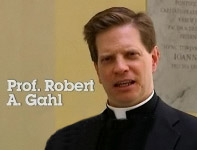
Father Bob Gahl

The seminar’s fourth day kicked off with a subject I have reported on extensively—stem cell research. Father Bob Gahl, a Santa Croce professor, discussed what the Church really teaches about stem cells. Contrary to what the mainstream media preaches, the Church is not against science. It is not against progress, and it is not against stem cell research. The Church has always maintained that human life must be protected at every stage—from conception to natural death. It just so happens that one form of stem cell research destroys human life. Embryonic stem cell research (ESCR) requires the destruction of a human embryo. As a former embryo myself, I fully concur with the Church’s position.

There’s one aspect of such research that the Church hasn’t conclusively addressed. There are about 400,000 frozen embryos living in suspended animation. Some Catholics favor embryo adoption where these embryos would be implanted in a woman’s uterus (with her consent) in order that they may be brought to term. The others options are few: the frozen embryos will be destroyed in research or they will be allowed to die a natural death. The former is immoral. The latter is not. The debate is whether it’s moral to implant an embryo (that is already created) which will either die in research or, once its “shelf life” is over, it dies a natural death. Our presenter, Fr. Gahl, said he doesn’t expect the Vatican to make a pronouncement for at least 10 years. The last Church document on stem cell research was Dignitas Personae (The Dignity of a Person), issued in 2008 by the Congregation for the Doctrine of the Faith. Although the CDF hasn’t hinted that it will issue a new bioethics document any time soon, many expect one in the next few years.
We don’t expect embryo adoption to be included in the document.

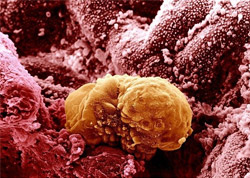
Colored image of a 6 day old human embryo implanting

Ultimately, Fr. Gahl said, the Church teaching on ESCR is based on the Biblical truth that human beings are created in the image and likeness of God and that Jesus Christ became flesh in his mother’s womb. Jesus, too, was once an embryo like all the rest of us. Science, Fr. Gahl said, has determined that within seconds of a sperm cell penetrating an egg, the cell “begins to act differently”—meaning that it is no longer two separate cells, but new creation, a human life. I often use the analogy that once a seed planted in the ground begins to sprout, it is alive. So too with a fertilized human egg.

Africa

Our Thursday afternoon session delved into the Catholic Church in Africa. What I expected to be a snoozer turned out to be one of the most interesting sessions of the entire seminar. Monsignor Fortunatus Nwachukwu, head of protocol at the Vatican’s Secretariat of State, delighted the entire group. The priest, who hails from Nigeria, began by discussing Vatican protocol, the ins and outs of the Holy Father’s foreign visits and his security, and the importance and reasons for the Holy See’s diplomatic outreach.

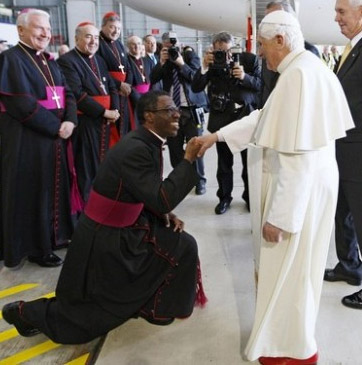
Monsignor Nwachukwu greets Pope Benedict on July 13, 2008, in Australia

The most fascinating aspect of his talk, however, centered on the African church. While the Church in Africa is celebrating a century since the last major wave of Catholic evangelization, the continent has biblical roots. Moses had an Ethiopian wife. Jesus went to Egypt as a child. Simon of Cyrene was African, from modern-day Libya in Northern Africa. After the first-century destruction of Jerusalem (70 AD), many Christians moved to Africa. The Church declined until a wave of Portuguese evangelization around 1600, Monsignor Nwachukwu said. The slave trade, however, decimated the Christian population in Africa.  Today, the Church in Africa is alive and vibrant, sending missionary priests to the United States, Canada and Western Europe.

Monsignor Nwachukwu noted that just as Arabic is a language that binds Islam together in prayer, Catholics must not forget that Latin has the same binding together effect for Catholics. He ended his talk by stressing that the Church cannot be allowed to fail in promoting reconciliation, justice and peace in every nation of the continent. This articulate 50-year-old priest will be one to watch as he rises through the ranks of the Vatican curia.

Benedict in the UK

Jack Valero

The Holy Father is scheduled to visit Glasgow, London and Birmingham from Sept. 16-19. He will meet Queen Elizabeth II and PM David Cameron. And he will beatify Cardinal John Henry Newman, the most distinguished Catholic convert of the 19th century. We had the distinct pleasure of hearing from Jack Valero, official spokesman for Newman’s beatification, on Thursday evening—a little more than a week before the actual event. This will be the first official state visit of a Roman pontiff to the United Kingdom in history. Technically, John Paul II’s 1982 trip to the UK was considered a pastoral visit. Pope Benedict was invited by then-Prime Minister Gordon Brown in early 2009.

Despite the incredibly secular culture in England, the state has been exceptionally accommodating for the papal visit, Valero said. The economic spin off from pilgrim spending will surely result in the state turning a profit. Another interesting tidbit Valero dropped was that Newman will be the first non-martyr Englishman to advance toward canonization in more than 400 years. Newman’s greatness, he said, was that he was willing to follow the truth wherever it led him.

Valero, himself, has made a big splash in the UK in the months leading up to the papal visit. He co-founded Catholic Voices, a team of 20 Catholic speakers able to articulate with conviction the Church’s positions on major contentious issues in the media. Since its launch in February 2010, the project has been reported in various magazines and newspapers. Its speakers have appeared in numerous public debates. They are professionally trained (thanks to Valero and his staff) to unflinchingly present the truths of the faith in a highly secularized culture. I told Valero that he should pursue a companion program for priests, bishops and seminarians.  God willing, the tide will turn in the UK with folks like Valero leading the way after the papal visit!

Pope Pius XII

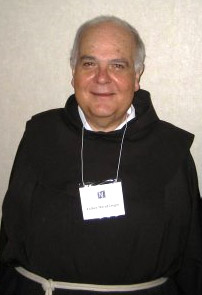
Fr David Jaeger OFM

We were treated to a delightful lecture from the first Israeli-born priest in centuries when Fr. David Jaeger, OFM, spoke to us about the controversy over Pope Pius XII and the Jews. I’ve written about this subject a time or two, so Fr. Jaeger’s talk was informative and delightful. He’s a man who doesn’t need a microphone and has no problem holding his entire audience in the palm of his hand.

Among the facts that seem lost commentators on this subject: Eugenio Zolli, the chief rabbi of Rome converted to Catholicism after World War II ended because of Pope Pius XII’s commitment to saving Jews during the war. Jewish leaders (and everyone in the know) considered Pius a “righteous Jew” until 1965 when a historically inaccurate play called The Deputy was published. The play alleged that the pope did little or nothing to help Jews during the war. Eventually books like Hitler’s Pope followed, exacerbating the invented controversy. Then in 2005, the Yad Vashem holocaust museum in Jerusalem put up a plaque dissing Pope Pius. Sadly, the controversy has cast a cloud over the Pius’ cause for canonization.

Attack on Ratzinger

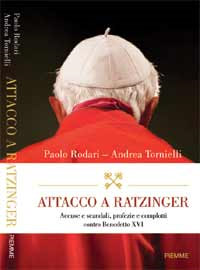
Attack on Ratzinger (book)Our final day in the classroom wrapped up on Saturday with an enthralling presentation by Andrea Tornielli and Paolo Rodari, authors of the newly released Italian-language book Attacco a Ratzinger: Accuse e scandali, profezie e complotti (Attack on Ratzinger: Accusations and Scandals, Prophecies and Plots).

Tornielli, one of the most respected Italian Vaticanisti, talked about attacks on the Pope that come from two distinct groups—from liberal progressives outside the Church that object to Catholic teaching on a wide range of subjects, and from those inside the Church who object to the Holy Father’s governance of the Church—including bishops who disagree with things like the Benedict’s motu proprio, the apostolic letter Summorum Pontificum announcing greater use of the Tridentine Mass, and his lifting of Bishop Richard Williamson’s excommunication despite the bishop’s denial of the full extent of the holocaust.

The Italian journalist, author and blogger argued that most Vatican critics have their mind made up about Benedict. They have a “frame” about him, and won’t accept anything that doesn’t fit in that frame.

Tornielli told us that the Roman curia structure hasn’t changed since Pope Paul VI’s 1967 reforms. All papal communication flows through the Secretariat of State, and the Holy Father doesn’t get information directly from the world’s bishops’ conferences or various dicasteries. The Vatican has, however, hired a Swedish company to monitor information about the Holy See on the internet, Tornielli said.

Both authors agreed that Pope Benedict is a very good communicator who addresses issues squarely. However, they also agreed that the Vatican really needs a communications strategy. It was clear from hearing from Tornielli, Fr. Federico Lombardi (director of the Holy See’s press office) and John Thavis (Rome bureau chief of Catholic News Service) that there’s tremendous lack of communication among the Vatican’s various departments, dicasteries, pontifical councils and the Pope’s personal staff. While it’s counterintuitive, Thavis told us earlier in the week that the disconnect in the Vatican works well. Tornielli was more ambivalent.

* * *

There’s so much more I could write about the seminar, but suffice it to say that Santa Croce’s School of Church Communications truly out did itself. This was its second seminar for journalists, and the next one is two years away. I expect it will fill up quickly.

Livin’ la vida Roma

9 Sep

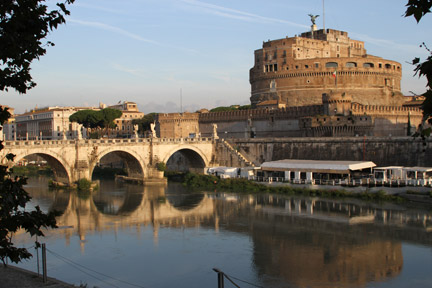
Castel San Angelo

SEPTEMBER 9, 2010 — Blogging from Rome isn’t easy. It’s like asking a child who rarely goes out to play to come in from the playground. To make that analogy complete … there’s no school bell. Rome is a Catholic playground in the sense that it’s one of the best places in the world to learn about and become immersed in our faith.

After landing in Rome on Sunday morning, I had two objectives: To find a Sunday Mass and to get some sleep. Both were easy to find. I took the Metro (train) from the airport to the Termini (main terminal downtown), then caught a short cab ride to my hotel. The guy behind the desk said my room wasn’t ready and he didn’t have a list of Mass times. I only had to wait 20 minutes before my room was ready, so I checked in then walked a block to the nearest church. If you’ve never been to Rome, you have to realize that churches are so close together in the main part of the city that you rarely have to walk more than two blocks to find one. Not only that, but most are huge, old and beautiful. Sadly, they are also under-used.

Vaticanisti
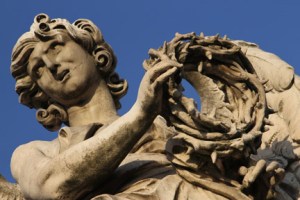
Angel on Ponte Sant'Angelo

The seminar I’m here for — The Church Up Close: Covering Catholicism in the Age of Benedict XVI — is being held at the Pontifical University of the Holy Cross (aka Santa Croce) — one of several pontifical universities and one of the newest. The course has attracted 27 journalists from eight countries. I initially expected the seminar would draw secular journalists who were eager to learn more about the Church and how it operates. However, most of the folks I’ve met here so far are pretty well-versed in Church teaching and its position on most issues. What I’m finding, however, is that we’re here for a deepening in our understanding on how the Church operates and its position everything from stem cell research, the sexual abuse crisis, poverty, and how the Holy See communicates with the world.
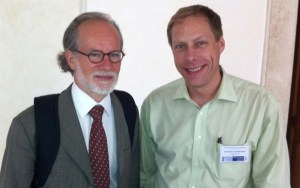
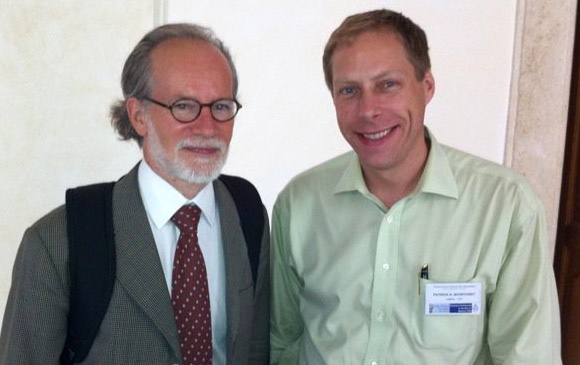
With John Thavis

Our first day, Monday, was a full day in the classroom. We were treated to a session on the nature and mission of the Catholic Church. Father Paul O’Callaghan, a Santa Croce professor, gave us a quick snapshot of the Church’s origin in the Jewish people through to Jesus Christ, the apostles and their successors. Later in the day, two “Vaticanisti” treated us to a few hours of what it’s like to be a full-time Vatican reporter. Catholic News Service Rome Bureau Chief John Thavis, whom I’ve met several times before, and Trish Thomas of the Associated Press TV, relished us with dozens of stories from their experiences with both Pope John Paul II and Pope Benedict. Both agreed that the most memorable and rewarding experiences came during papal trips overseas — in particular traveling on the papal plane.

Thavis talked about his first attempts to get interviews with Vatican cardinals. He quickly learned that “ambush interviews” don’t work, meaning that waiting to catch a cardinal or other church officially without making an appointment or putting in a request, just doesn’t fly. His point was that the learning curve for most Vaticanisti is rather long.

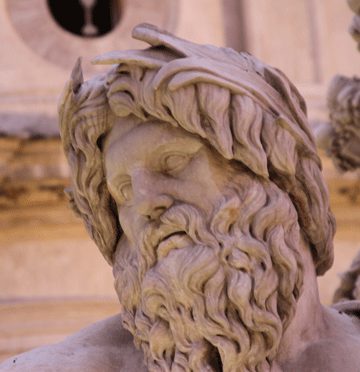
Detail of fountain, Piazza Navona

One of the more fascinating differences between Benedict and John Paul is the way they interact with journalists on the plane. Normally, 40-60 journalists travel on the pope’s plane when he travels abroad. John Paul occasionally waded into the crowd of journalists at the back of the plane. He sometimes sat and bantered with them for an extended period of time. Thavis said later journalists would share their taped interviews with the pope, which made for compelling stories. Pope Benedict, on the other hand, is more comfortable taking pre-submitted questions. Both Thavis and Thomas agreed that the pope isn’t afraid to choose from the tougher, more controversial questions. The answered a question about condom use on a trip to Africa several years ago. Both seemed to expect the pope’s upcoming trip to the UK will be a great success despite some of the controversies swirling about.

Inside the Vatican

St. Peter's Basilica in the morning light

I began this post talking about Rome as a playground for Catholics. Tuesday kicked off by a morning tour of the Vatican museums and the Sistine Chapel. Liz Lev, art historian and one of the best tour guides in the Eternal City, led us through three-hour blitz through the museums, capped by a fascinating visit to the Sistine Chapel. It was my third visit to the museums, but certainly the most in-depth experience.

Liz Lev leading our tour of the Vatican Museums

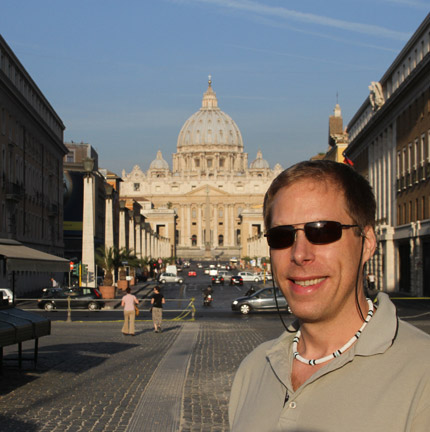
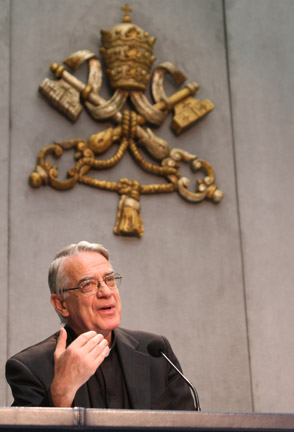
After a short break, we crossed the street to the road leading directly into St. Peter’s Square — Via Conciliazione — to the Holy See’s Press office. Papal spokesman Fr. Federico Lombardi, SJ, spent a full hour with us. He began by explaining the history and role of the Press Office. He talked about his work, his challenges, and how he interacts with the 400 journalists (Vaticanisti) accredited to the Holy See. One of the challenges the Press Office is the challenge of explaining the more complex Church documents and positions to journalists. Lombardi also stressed that it’s essential for the Church to be transparent in the more difficult questions posed to the Church, in particular the sexual abuse of minors.

Fr. Federico Lombardi, SJ, Director of the Vatican Press Office

The Holy Father will visit Glasgow, London and Birmingham next week. Father Lombardi said they feel no “trepidation” about the trip despite some popular atheists and groups calling for officials to arrest the pope. He said polls in the UK are mostly positive regarding the visit, and that the Pope will explain what the Church has to offer the people of England and Scotland.

Our evening session took place at the offices of the Congregation for the Doctrine of the Faith. American priest Monsignor Charles Brown, a staff member at the CDF, gave us a fascinating overview of the office’s history, its link to the Inquisition and its relationship to Pope Benedict, who was the prefect of the CDF before becoming pope.

Papal Audience

With Cardinal John Foley

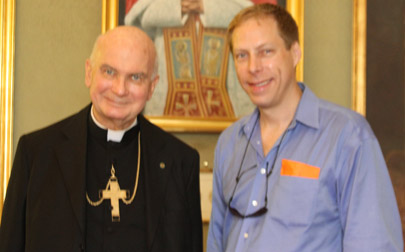
We were giving an all-access pass to the Roman playground on Wednesday. Our seminar group had tickets to the papal audience before a full afternoon of free time to tour the Vatican. Prior to the pope’s audience, I had the honor to spend 30 minutes with Cardinal John Foley, the grandmaster for the Knights of the Holy Sepulchre. I first met the cardinal in 2006 when he was the president of the Pontifical Council for Social Communications. We last met again last year in Jordan immediately after the papal Mass in Amman, Jordan. Certainly one of the warmest prelates I’ve ever had the pleasure to meet, Cardinal Foley always remembered my name despite the years between our meetings.
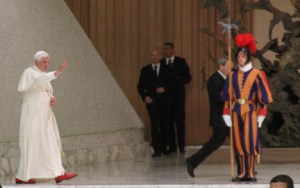
Pope Benedict XVI enters Paul VI Hall

I have attended at least two Wednesday public audiences at the Vatican during the time of John Paul II. The audience we attended was held in the Paul VI Hall, inside the walls of Vatican City. Completed in 1971, the hall holds 6,300 people. I found a seat in the front third of the hall. The Holy Father was wildly greeted as he entered the packed hall around 10:30 am, and even more so when he mentioned the various pilgrimage groups over the course of his talk, which he delivered in at least six languages: English, Italian, French, Spanish, Polish and German. Interestingly, our group was the first one he greeted when he spoke in English. Yay! Yeah, I cheered.

The teaching portion of his talk was on the 12th century saint and mystic, St. Hildegard of Bingen. He also talked about his upcoming visit to the United Kingdom, saying he was looking forward to the visit and to beatifying Cardinal John Henry Newman. Noting the prayers of the faithful for the success of his apostolic journey, the pope said, “Above all, I thank the countless people who have been praying for the success of of the visit and for a great outpouring of God’s grace upon the Church and the people of your nation.”

One of the best parts of papal audiences, generally attended by pilgrims to Rome from around the world, is the reaction of these groups when mentioned by the Holy Father or the priest announcing their presence. Polish seminarians broke into song, Mexican pilgrims waved banners and flags, and American parish groups cheered and stood on their chairs. Every time I attend one of these audiences, I’m reassured that the Church is alive, vibrant and truly catholic, that is, universal.

After a quick lunch in St. Peter’s Square, our group was split in two, for a guided tour of the “scavi,” the excavation site under St. Peter’s Basilica. In the 1930s, the Vatican commissioned archeologists to excavate the site in order to explore the remains of the original basilica, built in the fourth century, and the existence of St. Peter’s remains.

Today’s basilica is right beside what was once known as Nero’s Circus where St. Peter was crucified upside down for teaching the faith. His remains were buried a stone’s throw away in a nearby burial site, apparently between two brick walls in a pagan grave yard. When Constantine converted to Christianity in the fourth century, he decided to build a basilica on Peter’s tomb. I often marvel at the political capital he must have expended in building a church over a grave yard where some very wealthy Romans had buried their ancestors.

The hot, damp tunnels under the basilica led us to the pagan mausoleums, which were very well preserved. Buried in the fourth century to make way for the basilica, mosaics, paintings, urns and sarcophagi appeared much as they did 1500 years ago. One story above the tombs, were some remnants of Constantine’s basilica. Finally, the last stop of the scavi tour brought us to a room where we could see, behind glass and inside one of the original altars of the first basilica, an ancient box that holds St. Peter’s relics. I paused to remember my family, friends and their special intentions in a quick prayer to the first pope.

It was my third scavi tour. It never gets old … and not just because it is old (ha ha), but because it’s one of the most profound and tangible aspects of Christian faith. The man who walked on water, who spent three years with Jesus Christ, the man who denied him three times, and the man who was given the Keys to the Kingdom was right here with me. Our faith is tangible, it is historic and it is real.
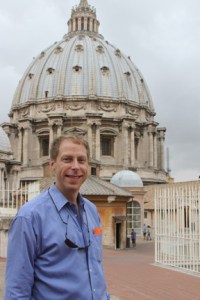
Atop St Peter's Basilica

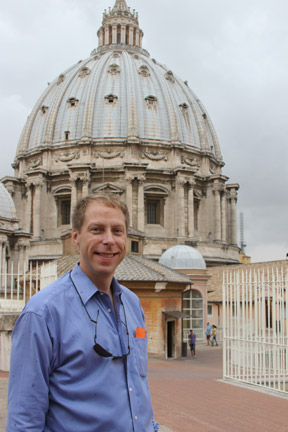
After viewing the tombs of the popes — including that of Pope John Paul II — below the basilica’s main floor, a few of us found our way from the scavi tour under the basilica to the cupola, nearly 450 feet (135 m) above the square below. We stood in the queue for about 20 minutes before dropping 7 euro to take the elevator to the basilica’s rooftop. From there, it was 320 windy, narrow stairs to the cupola. This was my third time on top of the famous basilica. It was windy, threatening to rain, but incredibly still crowded. The view of Vatican City and all of Rome is unbelievable.

We tried to visit the basilica’s adoration chapel after bringing ourselves to ground level. The priest had just begun benediction, so we were turned away by the guard at the door. No matter, we wandered about and found the glass coffins of a 17th century pope and that of Pope John XXIII, who died in 1963. About 10 years ago, his exhumed body was found to be partially in corrupt and placed in the upper floor of the basilica. His face is covered with a thin protective layer of wax.
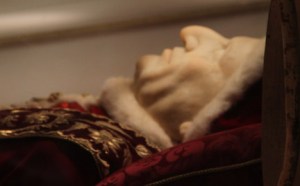
Pope John XXIII

We had to hurry back to the university, a 30 minute walk from the Vatican, for a fascinating session on canonical trials in the church by Monsignor Charles Scicluna, who works at the Congregation for the Doctrine of the Faith.

I don’t know if all of my readers find Rome — and this kind of in-depth exploration of the Catholic Church — as captivating as I do. I expect that if you’re reading this final paragraph, you do too!

In the coming days, we’ll learn more about the Church’s position on stem cell research, the Pope’s upcoming trip to the UK next week, the Vatican’s use of new technology, and we’ll wrap up on Sunday with a trip to Subiaco, the site of St. Benedict’s final monastery. I fully expect it will be as fascinating as what I’ve already experienced in my Roman playground. Stay tuned for my next blog post!

The journey begins

4 Sep

SEPTEMBER 4, 2010 — After a somewhat restless sleep, I rolled out of bed this morning at 6:30 am to take care of last minute emails and packing for my first trip to Rome since my honeymoon in 2002.

The world has seen a lot of change since then, as has the Church. I’ll never forget my last trip to St. Peters Square on April 17, 2002. Michele and I, dressed in our wedding clothes, anxiously awaited the pope’s arrival. The Popemobile entered the square to a triumphant wave of shouts, cheers and applause. Bent and frail, John Paul II made several rounds in the square before climbing the ramp to the stage area where we were sitting.

Despite the years that weighed so heavily on him, he waved off his aides who scrambled to help him out of the vehicle. He grabbed his cane and struggled to his feet, turned and made his way down the steps before walking to the presiders chair with his top aide, Bishop Stanislaw Dziwisz, holding his arm.

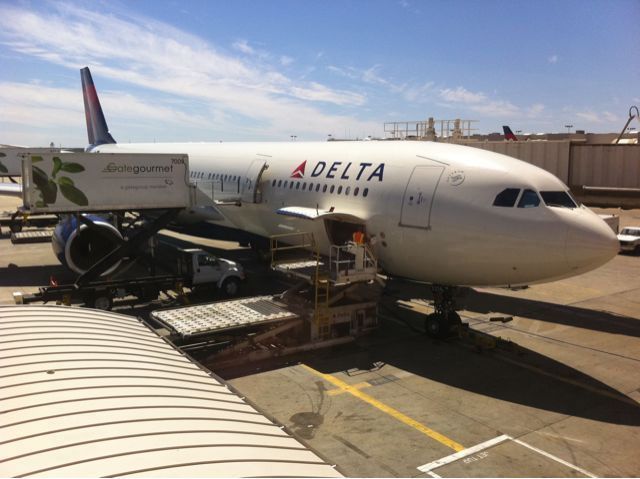
That was more than eight years ago. A lot of water under the bridge. Right now I’m in Atlanta’s Hartsfield International airport–the world’s busiest airport–looking at the 300-passenger Airbus 330 that will carry me across the ocean to the Eternal City. It’s my fifth time to Rome, having previously been there in 1997, 1998, 2000 and 2002. Since the city is about 14,000 years old (oldest archeological evidence of human activity), I doubt too much has changed.

The plane, boss, the plane! Airbus 330-300. Nice ride.

I’m going to be attending a week-long seminar at the Pontifical University of the Holy Cross for journalists from around the world who cover the Catholic Church. It’s billed as an insider’s look at how the Holy See operates. We’ll be making site visits, meeting the heads of some Vatican departments, and taking in a papal audience in St. Peter’s Square.

Time to board! Arrivederci, USA! More to come!

Fighting the good fight

2 Sep

SEPTEMBER 2, 2010 — The world is certainly a different place than when I attended college in the late 1980s. I studied at two secular schools and proudly lived my faith, joining Catholic clubs and attending Mass as often as possible on campus.

I can vividly remember talking to the Protestant students at the Campus Crusade for Christ table during orientation before later joining Catholic Christian Outreach, a dynamic movement of Catholic university students.

I encountered little hostility from students or professors. However, hostility toward Christians on secular college campuses has grown rapidly. A 2008 study by the Higher Education Research Institute at UCLA shows that college students tend to shift to more liberal positions on issues like gay marriage, abortion and religion from the time they are freshmen through their junior year.

That shift — facilitated by both peers and professors — was evident this summer as a number of students and professors who tried to live their faith on campuses across the country were summarily shut down.

Case in point: Dr. Kenneth Howell, a devout Catholic teaching at the University of Illinois, was terminated for simply answering a student’s email on what the Church teaches about homosexuality. Inexplicably, the firing was prompted by an anonymous email.

David French, senior counsel at the Alliance Defense Fund, told me that mainstream thinking in the academy is that traditional Judeo-Christian morality has no place in higher education. No debate. No discussion.

So what’s a Christian student to do when standing up for what you believe can get you expelled? You can always keep your faith to yourself. But Jesus says we’re not to keep our light under a bushel basket (Mt 5:15) and St. Paul tells us that we must fight to win (1 Cor 9:24-27).

We’re called to be a light to those who walk in darkness. Our example, our courage and the truth — even if it’s shut out of the debate — will eventually win out. But if we walk away and leave those who don’t know Christ to their own devices, their future (and their eternity) could be awfully grim.

In Dr. Howell’s case, he kept the faith. Within days, students — Christian and atheist alike — and the community rallied to his defense demanding academic freedom and a little common sense. The result? He got his job back.

We shouldn’t be surprised. The UCLA study I mentioned notes that despite the secularization of our public colleges and universities, 79% of college freshmen believe in God, and 69% pray and find strength, support and guidance in their religious beliefs.

The truth is that the vast majority of Americans outside the major urban centers are not sold on the secular left’s agenda to wean America of its religious heritage. We should never be afraid to stand up for the truth. Besides, God is on our side!

Patrick Novecosky is the founder and editor of The Praetorium.

Humility, humility, humility

16 Jul

JULY 16, 2010Someone once asked St. Bernard of Clairvaux what the three most important virtues are. He famously replied, “Humility, humility and humility.” Anyone who has studied the lives of the saints will tell you that this 12th century saint had it right. Humility is a prerequisite for sanctity.

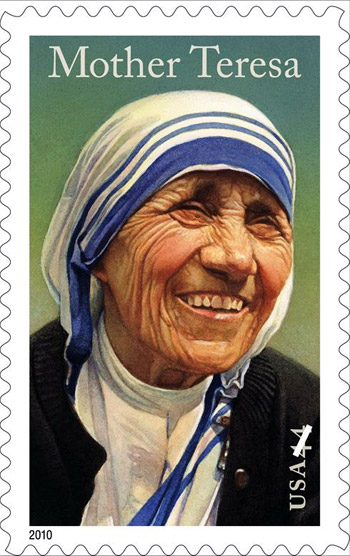
USPS will issue this stamp on the centenary of Mother Teresa's birth, Aug. 26, 2010.

Prior to Mother Teresa’s death in 1997, people called her a living saint precisely because she lived humility. She wore the same old, patched sandals until they fell apart. Everything she owned fit into a small bag, yet she built one of the largest, most vibrant religious orders of the 20th century.

As we close in on what would have been the famous nun’s 100th birthday on Aug. 26, we take a look in this issue at how she touched the lives of four Legatus members. (Click here for a related story.) On her birthday, the U.S. Postal Service will honor the Nobel laureate with a stamp bearing her image, and the Catholic League is working to have the Empire State Building lit up with blue and white lights in her honor. (Thus far, the owner of the building has refused; a petition and protest are in the works.)

Those who have read about the famous nun’s life often ponder how a diminutive little woman from Albania came to build an order of 4,500 nuns in 133 countries in less than half a century. There is no question that Mother Teresa’s secret is found in her total surrender to the will of God. Secondly, humility.

Legatus Magazine‘s July/August cover story relates how seminarian Christopher Nalty once rolled his eyes after hearing Mother give her “stump speech” to visitors on how many houses the order had. She wasted no time in setting the future priest straight.

“She turned to me and walked toward me, grabbed my shirt and said, ‘Look at me. I couldn’t do that. God did that,’” Nalty explained. “That’s the point I hadn’t gotten all summer! She wasn’t bragging. She was saying, ‘Look at what God did.’”

I didn’t have the opportunity to meet Mother Teresa myself, but a few months after her death, I had a sit-down interview with Sr. Nirmala Joshi, her successor as superior of the Missionaries of Charity. I asked her about Mother’s legacy, her work and Divine Mercy.

She told me that Mother learned about the Divine Mercy message and devotion shortly before her death. Then, just nine days after she died, the sisters began spontaneously praying the Chaplet at Mother’s tomb. “She did not know the Chaplet,” Sr. Nirmala said. “Her main devotion was the rosary. But her life was Divine Mercy.”

The one thing that I’ll never forget about that encounter with Sr. Nirmala was that the answers she gave were exactly what I’d expect to hear from Mother Teresa. In all things, she gave thanks to God, taking no credit for her work. In fact, Mother Teresa said she hand-picked her successor because she was among the least qualified. In that way, any success could only be attributed to God. Lesson learned.

Patrick Novecosky is the founder and editor of Legatus Magazine. This article appeared in the July/August 2010 issue of Legatus Magazine. Reposted with permission.

NBC’s new family-friendly TV movie

12 Jul

JULY 12, 2010 — In case you missed it, a new family movie is coming to NBC this Friday (July 16) at 8 pm Eastern (7 pm Central). I couldn’t resist blogging on this since the company promoting the film is none other Motive Entertainment (the company that has promoted family-friendly fare like  Polar Express and The Chronicles of Narnia). The company is headed by Paul Lauer. My first job south of the border was working for Paul’s YOU! Magazine (formerly Veritas) in 1996. He hired me as the magazine’s assistant editor and it changed my life. We’ll leave that story for another day.

The Jensen Project looks like another winner for NBC (trailer). Motive also promoted the Peacock Network’s last family-friendly movie, Secrets of the Mountain, which debuted on April 16 (USA Network) before airing on NBC last week (July 10).

Both movies are part of a collaboration between Walmart and P&G (Proctor & Gamble) called Family Moments. A third movie, A Walk in My Shoes, is already in post-production and will air later this year. P&G and Walmart will also begin production on their fourth movie this fall. A news release says that the two companies “decided to work together to create programming after hearing from families and advertisers who wanted more quality entertainment options. ”

Aside from the obvious need for more family-friendly entertainment, profit was certainly a motivator, too. Secrets of the Mountain, already out on video, was the highest-rated family movie on broadcast TV in the last six months (watched by more than 7.5 million people).

Justin Kelly stars as Brody Thompson in The Jensen Project

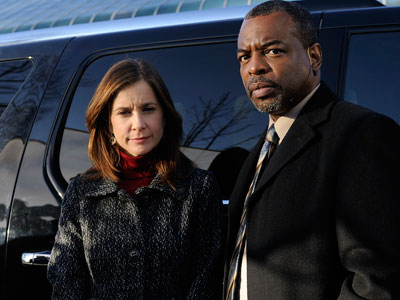
The production values and star power are notched up for The Jensen Project. On the bill are Patricia Richardson (Home Improvement) and LeVar Burton (Roots, Star Trek: The Next Generation). The film also boasts a soundtrack produced by music mogul Randy Jackson (American Idol) that includes songs from Jordin Sparks, Brooke White and Alisan, Ilsey & Jordan.

The story line looks intriguing: A secret community of geniuses conducts underground research to help solve some of the world’s most difficult problems. This sci-fi thriller tells the story of Claire (Kellie Martin, Mystery Woman) and Matt Thompson (Brady Smith), two former scientists who return to The Jensen Project after a 16-year absence.  Together, with their tech-savvy son Brody (Justin Kelly), the family is thrust into a frantic race to keep a potentially dangerous technology from falling into the wrong hands. As the family scrambles to stop the group’s rogue faction, they rediscover the importance of honesty, courage and being there for one another.

Motive’s news release touts the movie as “entertainment that the entire family can enjoy; since it’s on television, it’s essentially available for anyone to watch; and it’s something families can plan to do as an evening together.”

Kellie Martin and LeVar Burton star in The Jensen Project

Motive also noted that high ratings will illustrate to the entertainment industry that there is a significant audience for family movies and programs.

According to Motive’s Vote With Your Remote website, a recent study found that children spend more than 3,000 hours each year consuming entertainment, and a child will see an average of 200,000 violent images on television before age 18.

In addition, nearly 80% of parents expressed concern that “profanity, inappropriate sexual content and violence on TV programs has had a negative impact” on their children. Interestingly, The Jensen Project PR calls the movie family-friendly, but the trailer shows some violence, so take note that the movie may be friendly only if your family members are all over the age of 13.

Let’s hope viewership is through the roof on this one so Hollywood takes note of a vastly under-served market. Who knows, they may even start delving into an even more under-served market — Christian family films.

Patrick Novecosky is the founder and editor of The Praetorium.

Design a site like this with WordPress.com
Get started