Archive | culture RSS feed for this section

The Good Shepherd

11 May

MAY 11, 2009 — It’s amazing to think that in a country with only 109,000 Catholics, nearly a third of them piled into Amman’s International Stadium on Sunday for an open-air papal Mass. After departing the media center at 6:00 am, I expected the horde of media (yours truly among them) would be among the first to arrive, but a few hundred hearty souls were already in the stands when we pulled shortly after 6:30.

Thousands await Pope Benedict XVI at Amman International Stadium on Sunday, May 10. (Patrick Novecosky photo)

Thousands await Pope Benedict XVI at Amman International Stadium on Sunday, May 10. (Patrick Novecosky photo)

I spent a few hours talking to media from around the world, my colleagues from America, and a few Jordanians. Organizers had tapped the Jordanian Scouts and Girl Guides to help with logistics and crowd control. At least 100 teens dressed in their blue uniforms answered pilgrims’ questions and helped form a human barrier between the congregation and the yellow and white sanctuary on the east side of the stadium. The youth presence at the Mass was impressive. Hundreds of young people cheered and sang long before the Holy Father’s arrival. A song written especially for the papal visit — “Benvenuto Benedetto” (Welcome, Benedict in Italian) — rang through the crowd dozens of times throughout the morning.

Pope Benedict XVI enters Amman International Stadium in the Popemobile on Sunday, May 10. (Patrick Novecosky photo)

Pope Benedict XVI enters Amman International Stadium in the Popemobile on Sunday, May 10. (Patrick Novecosky photo)

True to form, the Holy Father arrived in the Popemobile punctually around 9:30, circling the stadium to the roar of about 30,000 enthusiastic souls. The yellow and white themed sanctuary was decorated with a large image of Christ, the Good Shepherd, because the Eastern Church was celebrating the fourth Week of Easter and Good Shepherd Sunday. They marked Easter one week later than in the West. An image of Mary and John the Baptist, patron of Jordan, also adorned the sanctuary.

Jordanian-born Archbishop Fouad Twal, patriarch of Jerusalem, warmly welcomed the Pope in English. He joked that the Church in Jordan is having a “vocations crisis” because its seminary is bursting at the seams and is struggling to find housing for the men eager to enter the priesthood.
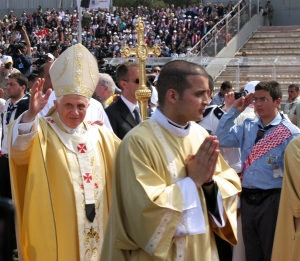
Pope Benedict XVI processes to the altar at the beginning of an open air Mass at Amman International Stadium on Sunday, May 10. (Patrick Novecosky photo)

Pope Benedict XVI processes to the altar at the beginning of an open air Mass at Amman International Stadium on Sunday, May 10. (Patrick Novecosky photo)

In his homily, the Pope exhorted the Middle Eastern Christians to stay in the Holy Land and give testimony to Jesus in this region so plagued by conflict.

“Fidelity to your Christian roots, fidelity to the Church’s mission in the Holy Land, demands of each of you a particular kind of courage: the courage of conviction, born of personal faith, not mere social convention or family tradition; the courage to engage in dialogue and to work side by side with other Christians in the service of the Gospel and solidarity with the poor, the displaced, and the victims of profound human tragedies,” he said.

An Iraqi Chaldean Catholic girl awaits her first Holy Communion from Pope Benedict XVI at Amman International Stadium on Sunday, May 10. (Patrick Novecosky photo)

An Iraqi Chaldean Catholic girl awaits her first Holy Communion from Pope Benedict XVI at Amman International Stadium on Sunday, May 10. (Patrick Novecosky photo)

The Mass concluded with 40 Iraqi Chaldean children receiving their first Holy Communion. Cardinal Emmanuel III Delly, patriarch of Baghdad, was among the dozens of priests and bishops concelebrating with the Holy Father.

After Mass, I talked to an American journalist who writes for the Jordan Times. The reporter was impressed with the high energy of the Mass — a rarity in this predominantly Muslim country. It was truly a celebration of Jordanian Catholicism, leaving enduring memories for thousands of the country’s faithful.

The promised land

9 May

MAY 9, 2009 — Moses wandered in the desert for 40 years before he saw the Promised Land. It took me almost 41. But my wanderings haven’t all been in the desert. Earlier today, about 150 people — media, guests, and clergy — gathered atop Jordan’s Mt. Nebo where Moses gazed out upon the Dead See and the land God had promised. As we waited for Pope Benedict to arrive, I looked out upon the land below and imagined what Moses felt after completing his earthly journey knowing that God had been faithful to his promise.

The media and honored guests waited in the ruins of a 6th-century church honoring Moses. It had replaced a 4th century church. When John Paul II visited Mt. Nebo in 2000, the church had a temporary roof and was functioning. Today, the roof and most of the support structure had been removed for a substantial restoration effort. The media perched upon dusty ancient walls and scrambled for the best vantage point to view the Holy Father give his speech.

Pope Benedict prepares to address pilgrims and media atop Jordan's Mt Nebo

Pope Benedict prepares to address pilgrims and media atop Jordan's Mt Nebo

When Pope Benedict arrived, shortly after 9 am, he was greeted with sustained applause. The brief service included a reading from Deuteronomy, recalling how Moses had seen the promised land, died, and was buried on the very mountain were on — 700 meters above the plain below.

The Holy Father said, “It is appropriate that my pilgrimage should begin on this mountain.” This holy place, he said, should remind all Christians to “undertake a daily exodus from sin and slavery to life and freedom.

“The magnificent prospect which opens up from the esplanade of this shrine invites us to ponder how that prophetic vision mysteriously embraced the great plan of salvation which God prepared for his people,” he said.

“Like Moses, we too have been called by name, invited to undertake a daily exodus from sin and slavery towards life and freedom, and given an unshakeable promise to guide our journey. In the waters of Baptism, we have passed from the slavery of sin to new life and hope.”

Pope Benedict gazes upon "the promised land" where Moses once stood atop Jordan's Mt Nebo

Pope Benedict gazes upon "the promised land" where Moses once stood atop Jordan's Mt Nebo

The Holy Father then walked 100 yards to a viewing platform and spent five minutes taking in view of the land bordering Israel, under the towering Brazen Serpent sculpture by Italian artist Giovanni Fantoni, before departing in the Popemobile.

After the Pope departed, I took my turn at the platform. I’ll post a photo when I have a few more minutes. Needless to say, the view is spectacular. Despite the years that have passed since Moses stood here, only one winding road has marred the landscape. Otherwise, it must have looked much as it does today. I’m confident that Moses left this spot confident that God had indeed been faithful and kept his promise. I couldn’t help but do the same.

…..

On Saturday afternoon, about 60 journalists boarded buses to St. George Melkite Cathedral in Amman. After waiting for about 90 minutes, the Holy Father arrived around 5:30 pm for a vespers service. From my perch in the choir loft, we had a phenomenal view of the fervent crowd of about 400 Greek Catholics gathered for the event. They greeted the Pope with incredible enthusiasm, testing the security details ability to keep him from being mobbed.

Pope Benedict prepares to address the faithful at St. George Melkite Cathedral in Amman, Jordan, on May 9.

Pope Benedict prepares to address the faithful at St. George Melkite Cathedral in Amman, Jordan, on May 9.

The hour-long service included heavenly music from several choirs who chanted and sang in Latin, Greek, and Arabic. The dignitaries included members of the Roman Curia — Cardinal Leonardo Sandri, Cardinal Tarcisio Bertone, Cardinal John Foley — and Orthodox Archbishop Benediktos Tsikoras as well leaders of a string of Eastern churches in union with Rome.

The Holy Father expressed his sincere thanks for the “opportunity to pray with you and to experience something of the richness of our liturgical traditions.”

“The Church herself is a pilgrim people and thus, through the centuries, has been marked by determinant historical events and pervading cultural epochs,” the Pope remarked. “Sadly, some of these have included times of theological dispute or periods of repression.”

“Others, however, have been moments of reconciliation — marvelously strengthening the communion of the Church — and times of rich cultural revival, to which Eastern Christians have contributed so greatly,” he continued.

Pope Benedict blesses the faithful gathered for vespers at St. George Melkite Cathedral in Amman, Jordan, on May 9.

Pope Benedict blesses the faithful gathered for vespers at St. George Melkite Cathedral in Amman, Jordan, on May 9.

“Particular Churches,” the Pope explained, “within the universal Church attest to the dynamism of her earthly journey and manifest to all members of the faithful a treasure of spiritual, liturgical, and ecclesiastical traditions which point to God’s universal goodness and his will, seen throughout history, to draw all into his divine life.”

As he left the cathedral, the devoted pilgrims again tested security in what, at times, seemed like a bit of a shoving match. However, the Pope seemed unfazed by the adulation as he beamed with joy and stretched to touch as many as he could. His Sunday Mass at Amman’s largest stadium will give even more of the faithful the opportunity to see the Pilgrim Pope.

On the ground in Jordan

7 May

MAY 7, 2009 — After months of planning and anticipation, I’m sitting on Royal Jordanian Flight 264, a direct flight from Chicago to Amman, Jordan.

This will be a short post because I’m tapping this out on my iPhone. In 12 hours, we will land 6,228 miles from home! What an adventure.

The Pope will be in the air to Jordan before we land … and he will land before we do. Time to fly!

…..

After a pleasant flight of limited sleep while cruising at 41,000 feet, I noticed the monitor said it was -83C outside. I pulled the blanket up over my head and was thankful for the airplane’s heating system. Before long it was morning… if you can call it that. We left Chicago at 9 pm, which was the middle of the night in Jordan. So morning was morning… but not really. The airplane breakfast cart came by with something that resembled (but didn’t taste like) breakfast at about 2 pm Jordan time, which stuck me as odd. However, the thought passed quickly.

By 4:30 pm, we were safely on the ground, briskly passing through security thanks to our hosts, the good folks at the JTB (Jordanian Tourism Bureau). I’m keeping company with four other U.S. journalists as part of this press tour. We joined a larger entourage of media from around the world at the Jordanian Cultural Center in downtown Amman at around 6:30 pm. After a press briefing in Arabic (I understood the Arabic words for “Pope” and “Roman Catholic”). Other than that, nada.

However, our group snagged a 10-minute audience with the spokesman for the Catholic Church in Jordan, Fr. Rifat Bader. He repeated the reason for the Holy Father’s pastoral visit: peace. “The Pope is coming to encourage pacemakers, peace-dreamers and all citizens of the Middle East,” he said.

Father Bader mentioned that the Holy Father broke protocol this afternoon in front of the Regina Pacis (Queen of Peace) Center this afternoon. He made a slight detour from the schedule to greet the young people who had been waiting for hours for the Pope’s arrival. “These are the future of the Church,” Fr. Bader said of the young people.

We then met with Islamic scholar Dr. Sheik Hamdi Murad who gave us a Muslim perspective on the papal visit. He was excited that the Holy Father was in town. He said the meeting between Jordan’s King Abdullah II and the Pope Benedict this morning “wasn’t a national event, but an important international event between Christians and Muslims.” He saw it as a historical meeting between two men of faith. The Sheik said that the tensions between the Pope and Muslims created by the Pope’s address in Regensburg, Germany, almost three years ago is in the past. “The page has turned,” he explained.

Jordan has about 200,000 Christians (4% of the population), half of whom are Catholic. Pope Benedict is the third pope to visit Jordan. Pope Paul was the first, visiting in 1964. John Paul II made his historic visit in 2000. I expect to see the fruit of these visits in the days and years to come.

Design a site like this with WordPress.com
Get started